

We use cookies to ensure that we give you the best experience on our website.
By using this site, you agree to our use of cookies. Find out more.
 February 05, 2026
|
February 05, 2026
|
 |
|
 Data Annotation
In today's world where AI is everywhere, data is super important for machine learning and AI models to do well. But just having data isn't enough. That's where data annotation comes in.
This blog is all about data annotation. We'll look at the different kinds, the tools people use, how it's done, what's new in data annotation trends, and how it's used in real life. We'll also talk about how professional data annotation services can help companies grow their AI projects without wasting time or money.
Data annotation is when you label data so that machine learning models can get it. If you want your supervised and semi-supervised learning models to work well, you need to have accurate labels.
Many companies are using data annotation services to get good data instantly and without spending too much.
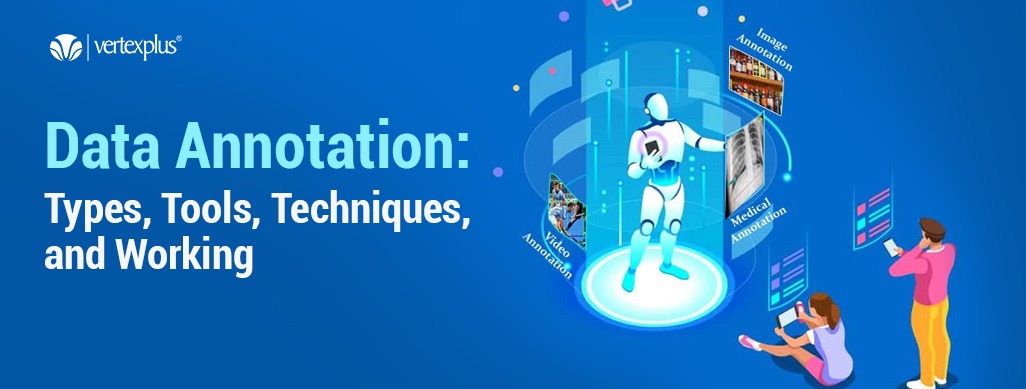
Different AI programs need different ways of annotating data. Here are some of the most common, such as text annotation, image annotation, Audio annotation, and Video Annotation.
Text annotation is when you label text so machines can understand what it means. Text annotation is frequently used in chatbots, search engines, ways to sort documents, and tools that figure out how people feel. Here are some ways to do it:
Image annotation is when you label images so computer vision models can learn. It helps computers recognize objects, people, places, and actions in a picture. It is required for facial recognition. medical scans, stores that use cameras, and cars that drive themselves. Here are some ways to do it:
Audio annotation is when you label sound files so AI systems can understand audio data. Audio annotation is often used in voice assistants, call centres, ways to understand speech, and tools that help people with disabilities. This involves :
Video Annotation is harder because you have to label objects, movements, and events in each frame of a video. It uses ideas from both image and time-based data annotation. Video Annotation is important for security systems, sports analysis, self-driving cars, and smart city programs. Here are some features you can use with Video Annotation:
Because people want annotated data, there are now better data annotation tools. These tools help make the process quicker, more accurate, and easier to manage. Many companies like to use data annotation and labeling solutions that have everything in one place, such as tools, skilled people to do the annotation, and ways to make sure the quality is good.
Here are some amazing functions that these tools perform:
There are various ways to annotate data, depending on what you need, how hard the data is to understand, and how much data you have.
Manual annotation is when people label the data themselves very carefully. This is good for complicated tasks like medical image annotation or figuring out how someone feels from text.
This is when computers label the data first, and then people check it. The AI models label the data, and the people make sure it's right. This way is faster but still accurate.
Automated annotation is when computers label the data without much help from people. It's cheap and fast, but you need to have people check the quality, especially if the data is hard to understand.
Professional data annotation services can take care of this whole process, so you can be sure it's done right and that you're following the rules. Here's how data annotation usually works:
Data Collection: Get the raw data (text, images, audio, or video) from the right places.
Data Preparation: Clean up the data and get it ready to be annotated.
Annotation Guidelines: Write clear instructions on how to label the data so everyone does it the same way.
Annotation Execution: Use data annotation tools and trained people to label the data.
Quality Assurance: Check the labeled data to make sure it's accurate and consistent.
Data Delivery: Give the finished data to the people who will use it to train machine learning models.
Data annotation can be used in many ways in different fields.
Labeled medical images and text help AI systems find diseases, make diagnoses, and do medical research. Image annotation and text annotation are needed to train healthcare models to be accurate.
Image annotation and Video Annotation assist self-driving cars in seeing lanes, people walking, traffic signs, and things in the way in real time.
Retailers use image annotation to recognize products, let people search using pictures, and manage what's in stock. They use text annotation to figure out how customers feel and to power chatbots.
Text annotation and Audio annotation help find fraud, process documents, verify people by their voice, and make customer service faster.
Video Annotation helps with things like moderating content, suggesting what to watch next, and making experiences more personal.
Also Read: Data Annotation: Types, Challenges, and Labeling Services
These data annotation trends show that it's important to have reliable partners and systems that can grow with you if you want to succeed with AI in the long run. As more people use AI, here are some things that are happening in the data annotation world:
If you want your AI models to be accurate and able to grow, you need to pick the right data annotation partner.
Professional data annotation services can help you save money, make your models more accurate, and get your products to market faster. Here are some things to look for:
Data annotation is the key to making AI and machine learning work well. Whether it's text annotation, image annotation, Audio annotation, or Video Annotation, good labeled data is what makes models perform well. With better data annotation tools, data annotation trends, and data annotation and labeling solutions, companies can get the most out of their data.
By putting revenue into the accurate data annotation strategies and data annotation services, companies can build smarter and more reliable AI systems that help them come up with new ideas and stay ahead of the competition.
Data annotation services give you labeled datasets that you need to train AI and machine learning models. They make sure things are correct, consistent, and can grow with you. This helps companies create dependable models quicker while cutting down on the work, money, and mistakes that come with labeling data by hand.
Data annotation and labeling solutions are complete packages with tools, trained people, workflows, and quality checks. Annotation is the actual labeling of data, while labeling solutions are full systems used to handle big annotation projects well.
The latest data annotation tools work with text, images, sound, and video. They usually have AI help, ways for people to work together, quality control, and workflow management. This makes annotation quicker and more precise for big companies dealing with tons of data.
The main trends in data annotation are AI helping with annotation, doing things automatically, working with different types of data, needing better training data, and paying more attention to data privacy and following the rules. These trends show that AI and Machine learning applications are getting more complex and bigger.
Sectors like healthcare, cars, stores, banking, and media get a lot out of text annotation, image annotation, sound annotation, and video annotation. You can do things like medical diagnosis, self-driving cars, catching fraud, managing content, and making user experiences personal.

Don’t Worry we are here to increase your business potential with our result-oriented solutions.


Leave a Comment
Your email address will not be published.