

We use cookies to ensure that we give you the best experience on our website.
By using this site, you agree to our use of cookies. Find out more.
.jpeg)
 December 26, 2025
|
December 26, 2025
|
 |
|
 Data Annotation
Data annotation has become the main source of modern artificial intelligence and machine learning systems. Without the usage of well-labeled data, AI models cannot detect and learn patterns, understand images, recognize voices, or process language accurately and easily. As industries grow, there is great usage of AI at a quick pace; the demand for better, scalable, and accurate data annotation continues to grow.
Today, data annotation is moving far ahead from basic data labeling. There are various trends that are changing how data is collected, processed, and prepared for smart systems. These advancements are assisting companies with lower costs, better accuracy, and speeding up AI development cycles.
In this blog, we explore the top 10 data annotation trends, upcoming shifts in the field, future technologies that will change data annotation, and what businesses should prepare for next.
Given below are the top 10 trends of data annotation for AI explained in a detailed manner.
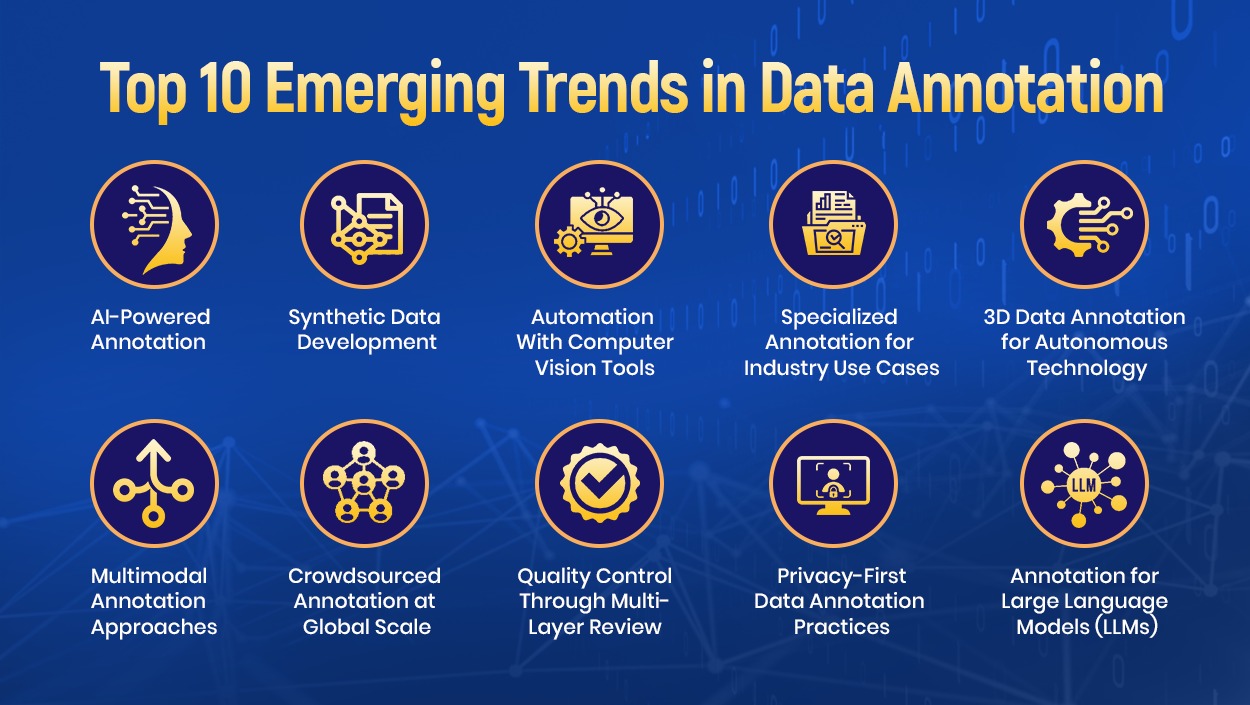
AI-powered tools can help annotators to speed up labeling tasks by instantly checking objects and reducing repetitive work. AI-assisted annotation increases efficiency by ensuring models pre-label data. It can also help human annotators focus on corrections, which could be one of the complex challenges of data annotation, difficult cases, and quality enhancement with data annotation tools are also important to keep in mind.
Synthetic data, called data annotation tools, uses computer-generated images or environments to develop labelled datasets when real-world data is less or not accessible to collect. Synthetic data helps companies scale annotation by creating accurate and real samples, minimizing data shortages, and improving model performance in diverse or rare scenarios.
Advanced vision tools can now easily automate bounding boxes, segmentation, tracking, and object detection without any human intervention. Computer vision automation minimises annotation time by enabling systems to auto-detect patterns, track objects precisely, and reduce major manual labeling efforts.
There are various Industries like healthcare, autonomous vehicles, retail, and agriculture, that require personalized annotation formats customized to their unique data requirements. Industry-specific annotation enhances accuracy because domain experts label complex data, which ensures models understand niche-specific patterns and specialized real-world scenarios effectively.
Self-driving cars, robotics, and drones majorly depend on 3D LiDAR and sensor data annotation to understand depth, motion, and object placement. 3D annotation increases spatial understanding by labeling point clouds with better precision that helps machines make safer, smarter, and more accurate and reliable navigation decisions.
AI systems now learn from combined data types such as text, audio, video, and images instead of depending on a single data source. Multimodal annotation enhances model intelligence by merging different data formats, creating proper training datasets that affect real-life environments more easily.
Platforms now connect global annotators, allowing organizations to label large datasets instantly using distributed teams across various locations. Crowdsourcing boosts speed and diversity by combining thousands of annotators that help companies produce detailed training data with lower costs and quick turnaround times.
Advanced QA workflows involve multiple checks and involve machine validation, human review, and consensus scoring for great accuracy. Multi-level quality control ensures reliable data by reducing errors, validating labels carefully, and providing consistent annotations that enhance model training results effectively.
New regulations require anonymized data handling, secure systems, and privacy-focused labeling processes across every annotation workflow. Privacy-first annotation safeguards sensitive information by applying strict security protocols, anonymization methods, and safe storage practices to maintain regulatory compliance at any time.
Data annotation tools called LLMs need huge volumes of text annotation, which involves sentiment tagging, intent classification, summarization, and conversation refinement. LLM-focused annotation improves language understanding by training models with structured linguistic data and develops proper reasoning, context recognition, and natural communication skills significantly.
Given below are the several data annotation trends that can happen in the future for upcoming growth.
Models may start learning from their own predictions with less human input, reducing the need for extensive manual labeling.
Self-learning models will gradually lessen human dependency by checking mistakes, refining predictions, and increasing accuracy through automated feedback loops designed to optimize performance and better efficacy.
There are industries such as medical imaging, autonomous driving, and legal AI that need accurate, domain-specific labelling.
Domain experts will become vital contributors by providing accurate interpretations, ensuring precise labels, and majorly enhancing AI reliability in complex or high-stakes environments.
A mix of machine automation and human review will form the foundation of most annotation pipelines.
Hybrid systems will deliver better quality by combining machine efficiency, human judgement, and smart tools, ensuring balanced growth and highly right annotation workflows everywhere.
There are various industries, such as retail analytics, autonomous vehicles, and surveillance, that need instant data processing.
Real-time annotation will enable fast decisions by labeling data quickly, supporting time-sensitive applications that depend on quick reactions and continuous system adaptability.
Organizations are moving toward uniform labeling structures to simplify training and model integration.
Standardization will smoothen the workflows by creating universal formats, minimizing mismatched datasets, and enabling smooth collaboration across tools, teams, and machine learning systems.
To enhance the future outcomes of data annotation, there are various technological trends you can see. There is a list of the same mentioned below:
Data annotation tech includes generative AI that will develop synthetic images, text, and videos instantly, reducing reliance on real-world data collection.
Impact: Generative AI will increase training cycles by generating rich, varied datasets, enhancing model accuracy, and easily cutting the time required to gather real samples.
Future tools will check context, tone, and intent more deeply for better language model training.
Impact: NLP advancements will enhance annotation quality by understanding complex linguistic patterns, enabling richer datasets and smarter language capabilities for trending AI systems.
Annotation will move closer to data sources using edge devices like cameras, sensors, and mobile tools.
Impact: Edge annotation will lower delays by processing data locally, increasing speed, security, and performance for applications requiring immediate analysis and less cloud dependency.
Blockchain will maintain transparent records of labeling actions, enhancing traceability and authenticity.
Impact: Blockchain technology will introduce secure audit trails by validating each data labelling step, improving trust, transparency, and integrity across large-scale annotation projects.
Future AI will require deeper emotion understanding to improve user experience and personalization.
Impact: Emotion-based annotation will enhance AI interaction by teaching systems to see complex human emotions. It makes digital communication more natural and adaptive.
Data annotation is coming into a new landscape, by AI-powered automation, synthetic data generation, and emerging industry needs. As organizations rely on Artificial intelligence, the demand for scalable and smart annotation processes will keep emerging and impacting the present times. You can reach out to us because as an IT consulting company in India, we can help you every step of the way.
The upcoming future of this technology will bring hybrid systems, expert-oriented data labeling, real-time processing, and creative technologies that develop annotation quicker and smarter. Businesses that use this technology early will get an advantage, as it ensures their AI solutions stay competitive, accurate, and effective.
AI-driven automation, multimodal labeling, advanced quality control, and reliable annotation workflows will majorly transform data annotation practices in different industries globally.
AI automation will minimize manual effort, speed up labeling tasks, and enable quick dataset development for advanced machine learning models.
Multimodal annotation supports models using combined text, image, video, audio, and sensor data and ensures good understanding across applications.
Future annotators will need technical understanding, domain expertise and the ability to integrate with AI-powered annotation platforms.
Strict privacy standards will require safe platforms, anonymization practices, compliance frameworks, and trusted workflows to safeguard sensitive information.

Don’t Worry we are here to increase your business potential with our result-oriented solutions.


Leave a Comment
Your email address will not be published.