

We use cookies to ensure that we give you the best experience on our website.
By using this site, you agree to our use of cookies. Find out more.
 May 21, 2026
|
May 21, 2026
|
 |
|
 Staffing Solution
In today s fast-evolving business landscape, organizations are no longer competing solely on products or services; they re competing for talent. As markets expand, technologies advance, and operational demands grow more complex, companies are increasingly turning to staffing solutions services to fuel sustainable growth. From startups scaling rapidly to enterprises optimising global operations, professional staffing has become a strategic cornerstone, especially when integrated with innovations like robotic automation and supported by proper infrastructure like a Network Operations Center (NOC).
Staffing solutions encompass a spectrum of workforce management services designed to align talent with business objectives. These include temporary staffing, temp-to-hire, permanent placement, contract staffing, and specialized IT or industrial recruitment. The overarching goal? To give companies the agility to adapt to market shifts without being bogged down by hiring bottlenecks. In essence, staffing solutions free businesses to focus on core operations while experts handle the complexities of talent acquisition.
Enterprises rely on staffing agencies because they:
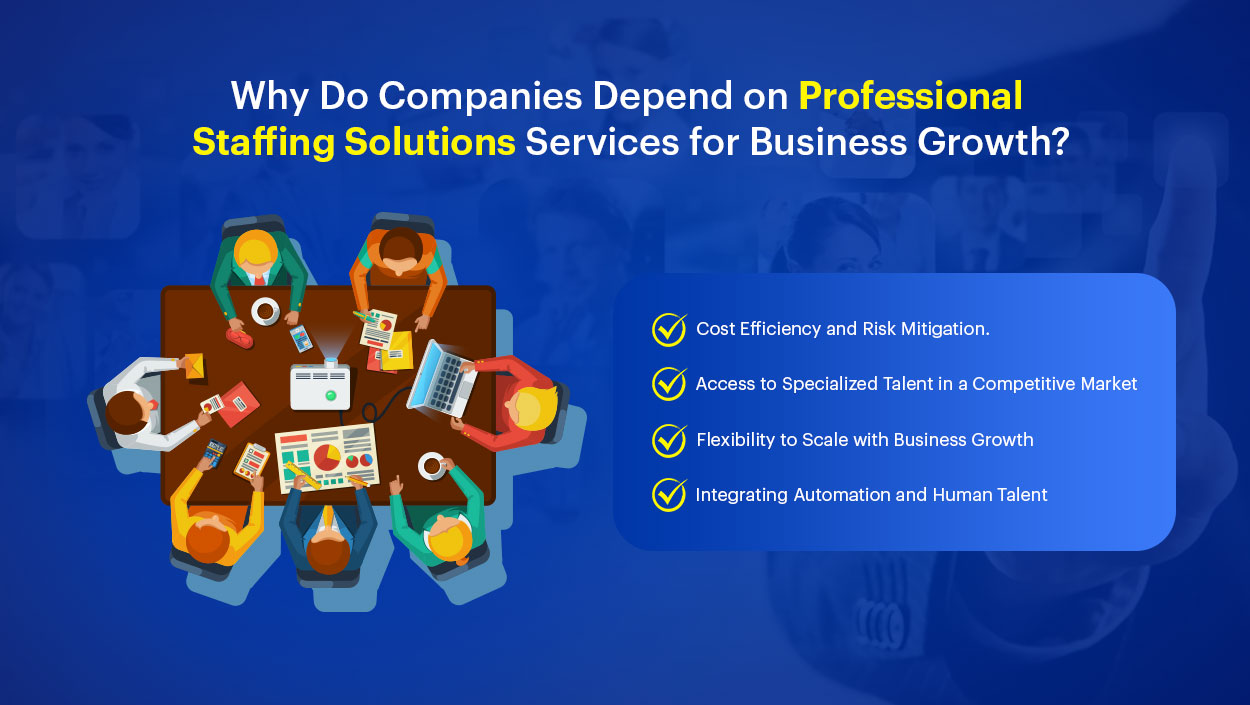
Traditional hiring involves substantial overhead: advertising, screening, onboarding, benefits, and legal compliance. Staffing solutions services transform this into a variable cost model, paying only for the talent needed . This is especially critical for companies navigating economic uncertainty or seasonal fluctuations.
Moreover, staffing partners mitigate legal and regulatory risk. In India, where labour laws are increasingly complex, agencies like those offering robotic automation in India ensure adherence to statutory requirements, reducing exposure to penalties.
Nowhere is the talent war more intense than in tech-driven fields like robotic process automation (RPA) and IT operations. Finding professionals skilled in RPA tools (e.g., UiPath, Blue Prism), NOC management, or automation architecture can take months through traditional recruitment.
Staffing agencies, however, have niche networks and technical assessors who can match your needs with verified experts in days. For example, companies implementing robotic automation in manufacturing or finance often require hybrid talent someone who understands both process engineering and software scripting. Staffing firms specialise in identifying such cross-functional professionals.
One of the most compelling advantages of staffing solutions is scalability. Consider a company launching a new line of automated services. It may need 10 RPA developers for six months, then scale to 30 as adoption grows. Hiring full-time employees for this trajectory would be financially risky. This flexibility is invaluable for businesses adopting robotic automation in India, where pilot projects often precede large-scale rollout.
With staffing partners, you can:
The rise of robotic process automation has not replaced humans; it has redefined their roles. RPA handles repetitive, rule-based tasks (e.g., data entry and invoice processing), freeing employees to focus on strategy, creativity, and customer engagement.
But implementing RPA requires skilled personnel to:
This is where staffing solutions services shine. They source professionals with proven RPA experience, ensuring smooth deployment and ROI. In India, a hub for robotic automation, staffing agencies now maintain specialized pools of RPA engineers certified in leading platforms.
As businesses digitise, maintaining 24/7 system reliability becomes critical. This is where a Network Operations Center (NOC) comes in a centralised facility monitoring IT infrastructure, detecting anomalies, and resolving incidents before they impact users.
Staffing agencies play a pivotal role in building NOC teams by sourcing the following:
For companies expanding into robotic automation in India, a robust NOC ensures that automated workflows remain operational, secure, and compliant. Staffing solutions thus bridge the gap between technology deployment and human expertise.
India has emerged as a global leader in robotic automation, driven by:
According to industry reports, India accounts for over 30% of global RPA implementation projects, with major adoption in banking, healthcare, and IT services.
Staffing agencies in India are uniquely positioned to support this growth. They understand local labour dynamics, cultural nuances, and skill gaps. For multinational corporations, partnering with Indian staffing firms offering robotic automation in India ensures access to cost-effective, high-quality talent without the burden of setting up local HR infrastructure.
A Bangalore-based fintech startup wanted to automate customer onboarding. Instead of hiring 15 full-time RPA developers, they engaged a staffing partner who:
A Jaipur-based manufacturer implemented robotic automation on its assembly line. Staffing solutions services supplied:
Result: 25% increase in output, 40% reduction in labour costs.

As AI, automation, and remote work reshape industries, staffing solutions will evolve from tactical hiring support to strategic workforce planning. In this new era, staffing solutions services are not just about filling roles; they re about building capabilities that drive long-term business growth. Companies that treat staffing partners as collaborators, not vendors, will gain the following:
Companies rely on staffing solutions services not just to fill vacancies but also to accelerate growth, mitigate risk, and access future-ready talent. In an age where robotic process automation, robotic automation in India, and Network Operations Center capabilities define competitive advantage, partnering with professional staffing providers is no longer optional it s essential.
Whether you re scaling a startup, optimising enterprise operations, or launching automation initiatives, staffing solutions offer the flexibility, expertise, and speed needed to thrive. The future of business growth lies not in how many employees you hire, but in how strategically you access talent.
1. How do staffing solutions services specifically support the implementation of robotic process automation (RPA) in Indian enterprises?
Staffing agencies in India maintain specialized talent pools certified in RPA platforms like UiPath, Automation Anywhere, and Blue Prism. They screen for both technical skills (bot development, orchestration) and domain knowledge (finance, healthcare workflows). This ensures that companies launching robotic automation in India get professionals who can design, deploy, and maintain automation solutions aligned with local regulatory and operational contexts.
2. Can a small business benefit from staffing solutions if it doesn t have a dedicated HR team?
Absolutely. Small businesses often lack HR infrastructure to manage recruitment, onboarding, and compliance. Staffing solutions handle end-to-end hiring, payroll, benefits administration, and legal compliance, allowing small teams to focus on product development and customer acquisition. This is especially valuable when scaling into automation or IT operations where niche skills are required.
3. What s the difference between traditional recruitment and staffing solutions when setting up a Network Operations Center (NOC)?
Traditional recruitment typically takes 6 12 weeks per hire and focuses on permanent roles. In contrast, staffing solutions offer accelerated hiring (often within 7 10 days) and flexible engagement models (contract, temp-to-hire). For a NOC, which requires 24/7 coverage and rapid scaling during incidents, staffing agencies provide pre-vetted engineers, shift flexibility, and immediate backup resources critical for maintaining uptime in automation-heavy environments.
4. How do staffing solutions mitigate the risk of skill obsolescence in fast-evolving fields like robotic automation?
Staffing agencies continuously update their candidate databases based on emerging tech trends. They assess certifications, hands-on project experience, and familiarity with the latest tools (e.g., AI-driven RPA, hyperautomation). By rotating contract staff or introducing temp-to-hire talent, companies can test new skill sets without long-term commitment, ensuring their workforce stays current with robotic automation advancements.
5. Is it cost-effective to use staffing solutions for pilot projects in robotic automation before committing to full-scale deployment?
Yes. Pilot projects carry high uncertainty; hiring full-time staff upfront risks sunk costs if the initiative doesn t scale. Staffing solutions allow companies to deploy contract RPA developers and NOC engineers for pilot phases. If the pilot succeeds, top performers can be converted to permanent roles via temp-to-hire. This approach reduces capital risk while validating automation ROI, a strategy widely adopted by firms implementing robotic automation in India.

Don’t Worry we are here to increase your business potential with our result-oriented solutions.


Leave a Comment
Your email address will not be published.