

We use cookies to ensure that we give you the best experience on our website.
By using this site, you agree to our use of cookies. Find out more.
 May 15, 2026
|
May 15, 2026
|
 |
|
 Data Annotation
Artificial Intelligence is changing the world fast. It is used in things like self-driving cars, robots that can talk to customers and security cameras that can think. But for Artificial Intelligence to work well it needs something important: good-quality data that is labelled. This is where data annotation services come in.
In this blog we will talk about why data annotation's so important for Artificial Intelligence. We will also talk about how it affects how well Artificial Intelligence works and how new tools and technology are helping to make it better.
Data annotation is the process of adding labels to data like text, images, audio and video. This helps machine learning models understand and learn from the data. For example, if we have a lot of pictures of cars we need to label them so the Artificial Intelligence system can recognize them.
If the data is not labelled properly, even the best algorithms will not work well. The truth is, Artificial Intelligence is only as good as the data it is trained on.
Good quality data is necessary for building Artificial Intelligence systems. Data annotation services make sure that raw data is changed into meaningful information. Proper labelling helps Artificial Intelligence models recognize patterns make predictions and make decisions.
For example, in healthcare, labelled medical images help models detect diseases. In retail labelled customer data helps with personalisation.
The accuracy of an Artificial Intelligence system depends a lot on how the training data is labelled. If the data is not labelled well, it can lead to predictions and unreliable outcomes. This can make the Artificial Intelligence system work better in real-life situations. Professional data annotation tools and human expertise make sure that the labelling is consistent and error-free. The model works well.
Data annotation plays a role in many Artificial Intelligence applications, including:
In computer vision, annotation involves labelling images and videos. This is very important in video analytics, where Artificial Intelligence systems analyse real-time footage to detect objects, track behaviour and detect anomalies.
Text annotation helps Artificial Intelligence understand language, sentiment, intent and context. This is important for Artificial Intelligence chatbot development, where chatbots rely on labelled data to respond accurately.
Audio annotation helps Artificial Intelligence understand speech patterns, accents and languages. This powers assistants and transcription tools.
Building an in-house annotation team can be time-consuming and expensive. Data annotation services have trained professionals and advanced tools, which ensures efficiency and quality. Outsourcing to these services allows businesses to scale quickly, reduce costs and focus on core development.
This ensures that the data is consistent, which is very important for model accuracy. Consistency is critical in Artificial Intelligence training. Annotation services follow quality assurance processes, including multi-level reviews, validation checks and standardised labelling guidelines.
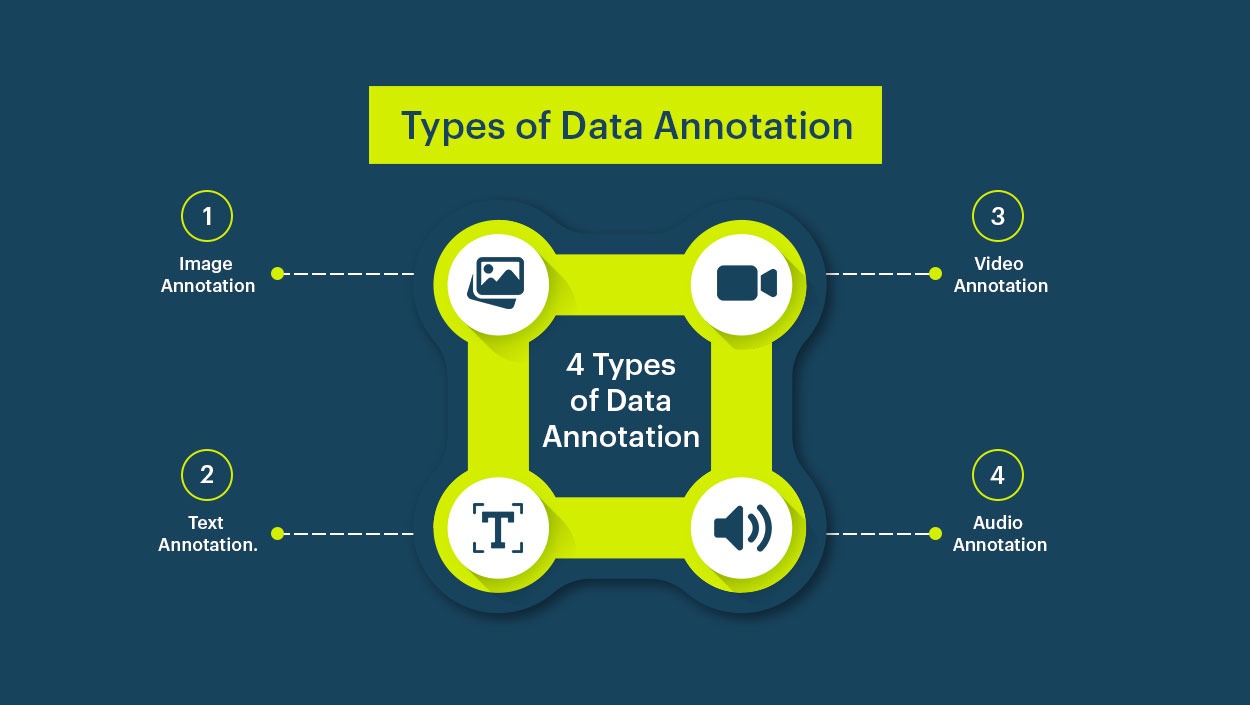
Image annotation involves labelling elements using boxes, segmentation and object tagging. This helps Artificial Intelligence systems recognize objects accurately, which is important for applications like self-driving cars, facial recognition and medical imaging.
Text annotation involves labelling language data by identifying entities, sentiment and intent. This helps Artificial Intelligence understand context and meaning, making it essential for chatbots, search engines, sentiment analysis and natural language processing.
Video annotation involves labelling objects and actions frame-by-frame within videos. This plays a role in video analytics, enabling Artificial Intelligence systems to track movements, detect behaviours and enhance applications like surveillance, traffic monitoring and security.
Audio annotation involves tagging sound data through transcription and classification. This helps Artificial Intelligence recognize speech, tone and context, supporting applications like voice assistants, speech recognition systems, call analysis and language processing solutions.
Data annotation tools have changed the labelling process by combining automation with human oversight. They speed up the annotation process while maintaining high accuracy levels. These tools offer features like:
AI-assisted labelling uses machine learning to pre-label data, reducing manual effort. Human annotators review and refine outputs, improving speed, consistency, and accuracy while accelerating the overall data annotation workflow significantly.
Real-time collaboration enables multiple annotators, reviewers, and managers to work simultaneously on datasets. It improves communication, speeds up project completion, ensures consistency, and allows instant feedback for higher-quality annotations.
Data management dashboards provide centralized control over datasets, tasks, and workflows. They help track progress, organize data efficiently, assign tasks, and monitor performance, ensuring smooth and structured annotation processes.
Quality control mechanisms include validation checks, reviews, and feedback loops to maintain annotation accuracy. They detect errors, ensure consistency, and improve dataset reliability, resulting in better-performing AI models and outcomes.
Video analytics is one of the growing Artificial Intelligence applications, used in security, retail and smart cities. For example, in surveillance, labelled video datasets help Artificial Intelligence identify unusual patterns, enhancing security measures.
Without proper annotation, chatbots may misinterpret queries, leading to poor user experiences. In Artificial Intelligence chatbot development, labelled conversational data is crucial. Chatbots rely on labelled datasets to:
Despite its importance, data annotation comes with challenges:
Handling massive datasets becomes challenging as annotation demands grow. Scaling requires workforce, infrastructure and time making it difficult to maintain speed without compromising accuracy or delaying Artificial Intelligence model development cycles.
Inconsistent or incorrect labelling reduces model reliability. Variations in annotator expertise, unclear guidelines or human errors can introduce bias leading to predictions and limiting the effectiveness of trained Artificial Intelligence systems.
Sensitive data like medical or financial information must be protected during annotation. Ensuring compliance with privacy regulations and preventing access is critical to avoid legal risks and maintain user trust.
High-quality annotation requires professionals, advanced tools and quality checks which increase expenses. Without a strategy costs can escalate quickly, especially for large-scale projects requiring continuous data labelling and updates.
Partnering with data annotation services helps overcome these challenges by offering:
Skilled annotators make sure data is labelled correctly and consistently. They use their knowledge. Follow set rules. This helps reduce mistakes and bias and improves data quality. Good data leads to AI models that work well and are reliable.
Advanced tools help annotators label data faster. They use automation. Ai to make the process quicker. These tools also help ensure accuracy make it easy for teams to work together and check the quality of the data. This makes it easier to prepare data for AI models.
Scalable solutions help annotation teams adjust to changing project needs. They can. Remove resources as needed. This flexibility ensures that large datasets are handled on time without sacrificing quality. It's perfect for AI development projects that are always evolving.
Strict protocols keep data safe during annotation. Measures, like encryption and limited access, protect the data. These protocols also ensure that regulations are followed, which helps prevent data breaches and keeps data private. This builds trust in the AI development process.
Industries using video analytics and Artificial Intelligence chatbot development will particularly benefit from these advancements. As Artificial Intelligence continues to evolve, the demand for quality annotated data will only increase. Emerging trends include:
Data annotation is not a supporting function. It is the backbone of successful Artificial Intelligence systems. From improving accuracy and performance to enabling applications like video analytics and Artificial Intelligence chatbot development, its role is indispensable.
Investing in data annotation services and leveraging advanced data annotation tools ensures that your Artificial Intelligence models are trained on high-quality data, ultimately leading to better outcomes and competitive advantages.
1. What are data annotation services?
Data annotation services involve labelling data like images, text, audio and video to make it usable for training Artificial Intelligence and machine learning models.
2. Why are data annotation tools important?
Data annotation tools streamline the labelling process, improve accuracy and enable management of large datasets, making them essential for scalable Artificial Intelligence development.
3. How does data annotation impact video analytics?
In video analytics, annotation helps Artificial Intelligence systems identify objects, track movements and detect patterns in video data, improving surveillance and monitoring capabilities.
4. What role does data annotation play in Artificial Intelligence chatbot development?
In Artificial Intelligence chatbot development, labelled text data helps chatbots understand user intent, respond accurately and deliver conversational experiences.
5. Can businesses perform data annotation in-house?
Yes, but it can be resource-intensive. Many organisations prefer outsourcing to data annotation services for scalability, quality and cost efficiency.

Don’t Worry we are here to increase your business potential with our result-oriented solutions.


Leave a Comment
Your email address will not be published.