

We use cookies to ensure that we give you the best experience on our website.
By using this site, you agree to our use of cookies. Find out more.
 June 23, 2026
|
June 23, 2026
|
 |
|
 AI chatbot
Single AI agents are just the beginning. The real transformation is happening where multiple specialized AI agents collaborate to solve complex problems that no single agent could handle alone. In 2026, multi-agent AI systems are rapidly becoming the backbone of enterprise productivity with the help of enterprise assessment services, automating workflows that previously required entire teams of humans.
Gartner recorded a staggering 1,445% surge in multi-agent system enquiries between Q1 2024 and Q2 2025, signalling massive enterprise interest. By the end of 2026, analysts project that 60% of enterprises will use AI agents, with multi-agent systems delivering a 25% increase in automation efficiency over single-agent approaches.
This isn't theory. Fortune 500 companies are already deploying multi-agent systems to automate investment research, customer service, supply chain management, and financial operations, achieving 70-80% reductions in manual effort while improving accuracy and speed.
The multi-agent AI market is experiencing unprecedented growth:
A multi-agent system (MAS) consists of multiple autonomous AI agents working collectively to perform complex tasks on behalf of a user or organisation. Unlike single agents that try to do everything, multi-agent systems employ role-specific agents that each specialise in particular domains while collaborating seamlessly.
| Single Agent Approach | Multi-Agent System Approach |
| Multiple specialized agents, each excelling at specific functions | Multiple specialized agents, each excelling at specific functions |
| Performance degrades with complexity | Each agent focuses on its domain of expertise |
| Limited scalability | Components can be added or upgraded independently |
| Higher risk of errors | Agents validate each other's outputs through collaboration |
Multi-agent systems solve complex, multi-stage, large-scale problems by dividing work among specialized agents and they even use staffing solutions services in a better way, enabling human teams to focus on higher-value strategic work. A marketing agent can negotiate resource allocation with sales and product development agents, while a finance agent evaluates proposals from operations, each maintaining their expertise while collaborating toward business outcomes.
The productivity gains from multi-agent systems come from orchestrated collaboration, not just automation. This orchestration creates a productivity multiplier effect: the combined output of specialized agents working together exceeds what any single agent could achieve alone. These systems employ multiple, role-specific AI agents to:
Industry analysts are calling 2026 "the year of multi-agent systems". The AI agents' boom of 2025 made automation accessible, but the next phase, multi-agent systems, will determine which companies turn that access into measurable value.
Successful multi-agent systems require API-driven architecture allowing agents to fluidly access nearly 900 different enterprise applications on average. Without seamless connectivity, agents remain trapped in silos, unable to share context or collaborate on end-to-end complex tasks.
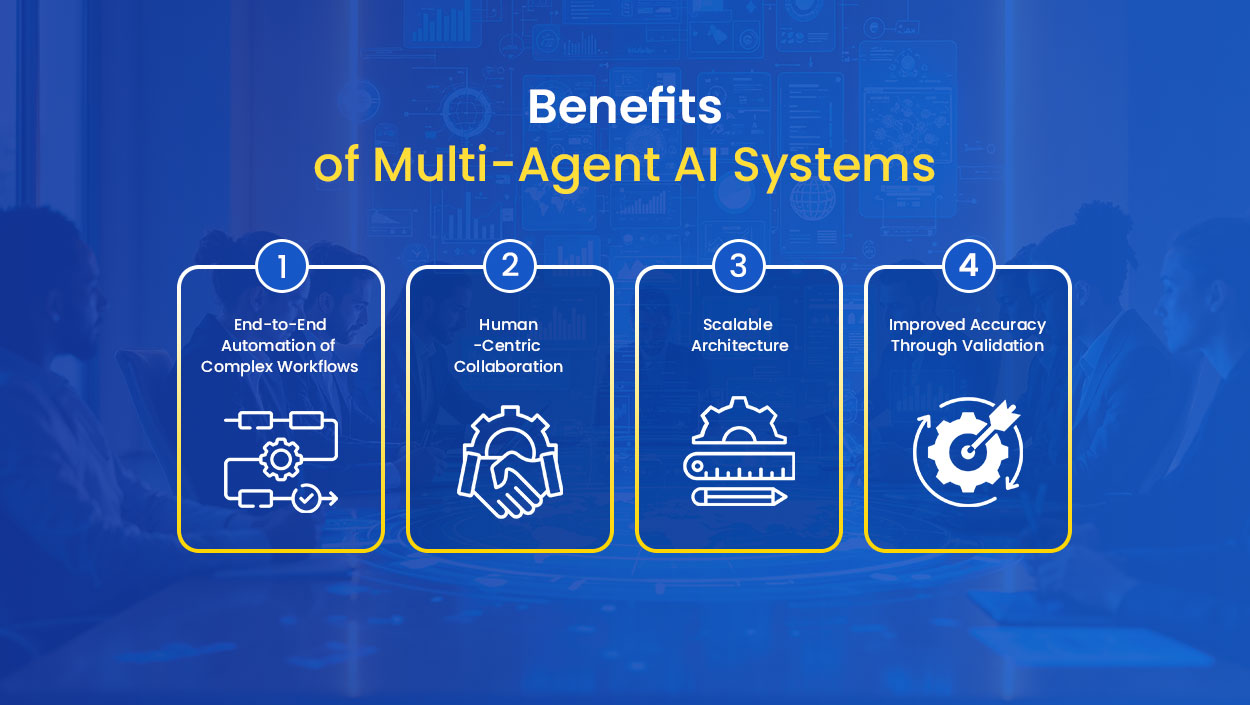
1. End-to-End Automation of Complex Workflows
Multi-agent systems transform fragmented enterprise processes into cohesive, intelligent networks that work together seamlessly with staffing solutions services. They automate workflows spanning multiple departments, systems, and decision points that previously required extensive human coordination.
2. Human-Centric Collaboration
Rather than replacing humans, multi-agent systems augment human capabilities. They handle routine tasks while escalating complex decisions to human experts, creating human-in-the-loop workflows that maintain accountability.
3. Scalable Architecture
Each agent can be selectively augmented when it becomes a bottleneck, making the system more scalable than working with one big model. This modularity allows organizations to start small and expand as they prove value.
4. Improved Accuracy Through Validation
Multiple agents validating each other's outputs reduces errors. JPMorgan's multi-agent investment research system improved accuracy from 50% to 90%+ through iterative development and evaluation-driven approaches.
JPMorgan Chase's Private Bank needed to automate investment research for thousands of financial products with billions of dollars in assets at stake. Single chatbots couldn't handle the complexity of financial analysis requiring data from multiple sources, regulatory compliance checks, and human oversight for high-stakes decisions.
JPMorgan built "Ask David", a sophisticated multi-agent AI system with a carefully designed architecture:
| Agent Type | Role |
| Supervisor Agent | Orchestrates workflow, routes queries to appropriate sub-agents |
| Specialized Sub-Agents | Each handles specific domains: financial data analysis, regulatory compliance, market research |
| Human-in-the-Loop | Subject matter experts validate high-stakes decisions, bridging the "last mile" from 90% to 100% accuracy |
| RAG System | Retrieves relevant information from knowledge base using Retrieval-Augmented Generation |
The team evolved from simple ReAct agents to complex sub-graph systems through iterative development, applying rigorous evaluation methodologies to measure and improve performance.
| Metric | Impact |
| Accuracy | Improved from 50% to 90%+ for domain-specific queries |
| Automation | 80% of investment research automated, humans handle exceptional cases |
| Efficiency | Research that took hours now completes in minutes |
| Scale | Covers thousands of financial products across multiple asset classes |
| Compliance | Built-in regulatory checks ensure all recommendations meet compliance standards |
The Challenge
A Fortune 500 SaaS leader struggled with inefficient lead qualification processes, where sales teams spent 70% of their time on manual qualification tasks rather than closing deals. They needed to automate pre-sales engagement while maintaining personalisation and improving data quality.
Implementation Strategy
Jade Global deployed AgentForce, an autonomous digital SDR (Sales Development Representative) powered by Salesforce's multi-agent architecture. The system integrated multiple specialized agents within the Salesforce ecosystem:
| Capability | Implementation |
| Agentic AI Decision-Making | Atlas Engine enables reasoning through complex user intent, executing tasks like lead qualification and routing |
| Dynamic Context-Switching | Agent switches between sales qualification and support triage without human handoff |
| Conditional Routing | Determines whether to direct users to Marketo forms, live agent queues, or self-service content |
| System Integration | Connects Salesforce Service Cloud, Marketo, and Freshdesk for seamless data flow |
| Human-Centric Conversations | Transforms static forms into dynamic two-way conversations, reducing friction |
The solution required a comprehensive Enterprise Assessment to identify pain points, map workflows, and design agent roles before deployment
1. Invest in Data Harmonization First
Years of vertical optimization produced isolated functions and incompatible systems. The same customer may appear as a "premium member" in service records, "Account #47382" in billing, and an email in marketing, three disconnected identities that agents can't reconcile without harmonised data.
Data infrastructure work is unglamorous, but it's foundational. Multi-agent coordination can't function without shared understanding across domains.
2. Build Reliable Governance Frameworks
Before agents begin making autonomous decisions, enterprises must establish governance frameworks defining:
Building these frameworks now while stakes are relatively low is easier than retrofitting them later when agent-to-agent commerce is routine with staffing solutions services.
3. Orchestrate Across Functions, Not Departments
Traditional organisation around customer journey stages created vertical silos with separate budgets, tech stacks, and incentives. Multi-agent systems enable horizontal optimization, making trade-offs across functions to achieve business outcomes rather than departmental metrics. This is the real transformation: not just efficiency but systemic coordination.
4. Use Specialized Staffing Solutions
Building internal multi-agent AI expertise requires specialized talent that's in short supply. Partnering with staffing solutions services accelerates team building while maintaining quality standards [keyword: staffing solutions services].
Companies using specialized staffing solutions services reduce time-to-hire for AI engineers by 60% and achieve 90% retention rates compared to traditional hiring.
As enterprises scale multi-agent AI, Mobile app development becomes critical for delivering AI capabilities to sales personnel, field workers, and customers [keyword: Mobile app development]. AI integration in enterprise mobile apps transforms them from simple interfaces into intelligent decision-support systems.
Multi-agent systems embedded in mobile apps enable the following:
Multi-agent AI systems are becoming enterprise productivity engines because they solve problems that single agents cannot: complex, multi-stage workflows requiring specialized expertise, cross-functional coordination, and human oversight where it matters most.
The window for deliberate preparation is open now. Enterprises that invest in multi-agent systems today will write the rules for agent-to-agent commerce and create competitive advantages that competitors can't easily replicate. Those that delay risk operating under infrastructure established by first movers, potentially being relegated to commodity status in ecosystems they no longer control with mobile app development services.
Ready to transform your enterprise productivity with multi-agent AI? Start with a comprehensive Enterprise Assessment to identify high-impact automation opportunities, leverage staffing solutions services to build your AI team, and integrate AI capabilities into your mobile app development strategy for maximum reach.
1. What is the difference between a single AI agent and a multi-agent AI system?
A single AI agent tries to handle all tasks with one model, while a multi-agent AI system uses multiple specialized agents that each excel at specific functions while collaborating seamlessly. Multi-agent systems deliver 25% higher automation efficiency and handle complex, multi-stage workflows that single agents cannot.
2. How quickly can enterprises implement multi-agent AI systems and see ROI?
With proper planning and experienced partners, enterprises can deploy multi-agent systems in 4-6 months and achieve ROI within 6-12 months. The SaaS company case study achieved a 70% reduction in manual effort and 80% automation of lead qualification within the first quarter of deployment.
3. Do multi-agent AI systems replace human workers entirely?
No. Multi-agent systems are designed for human-in-the-loop collaboration, handling routine tasks while escalating complex decisions to human experts. JPMorgan's "Ask David" achieves 90%+ accuracy through AI automation, but subject matter experts validate the final 10% for high-stakes investment decisions.
4. What infrastructure is required to support multi-agent AI systems?
Successful multi-agent systems require API-driven architecture connecting approximately 900 enterprise applications, harmonised data across systems, and robust governance frameworks. Without proper data harmonisation, agents can't reconcile disparate customer identities or share context effectively.
5. How do I build the right team for multi-agent AI implementation?
Building internal multi-agent AI expertise requires specialized talent that's in high demand. Partnering with staffing solutions services accelerates team building while maintaining quality standards—reducing time to hire for AI engineers by 60% and achieving 90% retention rates. Start with an Enterprise Assessment to identify skill gaps, then leverage specialized staffing partners to fill critical roles while training internal teams

Don’t Worry we are here to increase your business potential with our result-oriented solutions.


Leave a Comment
Your email address will not be published.