

We use cookies to ensure that we give you the best experience on our website.
By using this site, you agree to our use of cookies. Find out more.
 June 02, 2026
|
June 02, 2026
|
 |
|
 Video Analytics
In today's fast-paced business environment, organizations that harness data-driven insights gain a decisive competitive edge. Among the most transformative technologies emerging in this space is video analytics, a powerful tool that converts raw video footage into actionable intelligence in real time. From retail stores to airports, manufacturing plants to healthcare facilities, businesses worldwide are using video analytics solutions to make faster, smarter decisions that drive operational efficiency, enhance security, and boost revenue.
The global AI video analytics market was valued at USD 6.87 billion in 2025 and is projected to grow from USD 7.91 billion in 2026 to USD 21.45 billion by 2034, exhibiting a remarkable CAGR of 15.3%. This explosive growth underscores a fundamental market shift: organizations no longer view video surveillance as passive monitoring but as an active intelligence-gathering asset.
Let's explore the top benefits of video analytics technology for real-time decision-making, backed by industry trends, expert perspectives, and real-world case studies.
North America holds the largest market share, followed by Asia-Pacific, which is expected to grow rapidly due to government initiatives and retail sector expansion. The video analytics market is experiencing explosive growth:
Key growth drivers include:
Video analysis software uses artificial intelligence (AI) and machine learning algorithms to process and interpret video data in real time. This technology enables automated detection, recognition, and analysis of objects, behaviours, and patterns within video streams, transforming raw footage into actionable insights. These capabilities are deployed across diverse sectors such as public safety, retail, transportation, smart cities, healthcare, and industrial automation, enhancing operational efficiency and security.
Key functionalities include the following:
The most immediate benefit of video analytics is its ability to detect security threats instantly. Traditional surveillance systems require human operators to monitor multiple screens, a task prone to fatigue and oversight. AI-powered video analytics solutions automatically detect suspicious activities like intrusion, unauthorized access, or unusual behaviour patterns, triggering immediate alerts.
According to industry research, advanced algorithm technology in video analytics enables examination of captured videos frame by frame, irrespective of light exposure, making it a reliable choice for ensuring security. This capability is particularly crucial for preventing crimes before they escalate.
Video analytics transforms operational workflows by automating manual monitoring tasks. Organizations report significant reductions in labour costs while improving accuracy. The technology identifies inefficiencies in real time , whether it's idle employees on a factory floor, bottlenecks in assembly lines, or underutilised checkout lanes in retail stores.
A manufacturing case study demonstrated that implementing an AI-powered video analytics solution improved workforce discipline, enhanced safety compliance without manual enforcement and reduced dependency on continuous human supervision. The results included faster identification and resolution of behavioural violations and better visibility into shop-floor operations.
In retail environments, video analysis software provides unprecedented insights into customer behaviour. Organizations can track footfall patterns, measure dwell times at specific displays, analyse gender bifurcation, and assess shelf space attractiveness. Superstores and megamarts have started implementing these systems to gain insight into consumer behaviour, leading to more effective marketing strategies.
This data enables businesses to:
The ability to respond to incidents as they happen, not after the fact is perhaps the most powerful benefit of real-time video analytics. When the system detects an anomaly, it immediately alerts relevant personnel, enabling rapid intervention.
This capability is critical in:
Healthcare
Detecting patient falls or medical emergencies instantly
Airports
Identifying security threats or congestion before they escalate
Manufacturing
Alerting supervisors to safety violations before accidents occur
Retail
Preventing theft by alerting security staff to suspicious behavior
Modern video analytics solutions go beyond detecting current events , they predict future outcomes. By analysing patterns over time, AI can forecast crowd density, predict equipment failures, or anticipate safety hazards before they materialise.
The integration of AI and machine learning is leading to smarter, more adaptive and proactive video analytics. A large percentage of businesses have already adopted AI-enabled tools, illustrating the growing importance of these technologies.
One of the most practical benefits is the ability to integrate video analysis software with existing CCTV infrastructure. Organizations don't need to replace entire surveillance systems they can upgrade by adding AI capabilities to current cameras.
The deployment can be carried out without disrupting existing operations, making adoption much easier for organizations with established security infrastructure. Cloud deployment segments are growing at a CAGR of 24.6% and accounted for 60.3% market share in 2022, demonstrating the shift toward scalable cloud-based.
Perhaps the most transformative benefit is how video analytics informs strategic business decisions. The technology collects and analyses both structured and unstructured data, providing a comprehensive view of operations across multiple platforms.
This enables executives to:
Processing video analytics at the edge (on the camera itself) rather than sending data to centralised servers reduces latency dramatically. This is critical for real-time decision-making where milliseconds matter.
Expect a surge in video analytics for monitoring that integrates with other data sources such as acoustic analysis, sensor data, and IoT devices, creating holistic monitoring ecosystems.
AI enables automated extraction of insights, predictions, and patterns from data, significantly improving the speed and accuracy of decision-making. Organizations are using AI-driven hyper-personalisation to tailor experiences to individuals using detailed customer data.
The software segment is growing at a CAGR of 21.65%, with cloud solutions leading adoption. This shift enables smaller organizations to access enterprise-grade video analytics solutions without massive infrastructure investments.
Walmart, the global retail giant, has leveraged artificial intelligence to enhance its retail analytics empire. In the highly competitive retail sector, understanding customer behaviour and optimising operations are key to success.
Over 30 case studies from suppliers across the U.S., Mexico, and Canada reinforced how first-party insights from Scintilla are delivering measurable business growth. Walmart implemented an AI-powered retail analytics system that utilises machine learning algorithms and data analytics to transform its operations. Key components include:
The implementation of AI-driven retail analytics at Walmart yielded several significant benefits:
Working with an experienced AI consulting company can help organizations replicate Walmart's success on a smaller scale, ensuring proper implementation strategy and avoiding common pitfalls.
Integration matters
Seamlessly connecting new AI systems with existing infrastructure is critical for success
First-party data is invaluable
Direct insights from your own systems provide more accurate predictions than third-party data
Scale creates value
Walmart's massive data volume enables more accurate AI models than smaller retailers could achieve alone
London Heathrow Airport, Europe's busiest airport hub, faced chronic challenges with passenger congestion at security and immigration areas. Traditional staffing approaches couldn't adapt to fluctuating passenger volumes throughout the day.
The project used machine learning techniques to generate real-time quantile forecasts and copula-based simulation methods for aggregate forecasts.
The system was implemented at Heathrow Airport in 2017, and its real-time predictions are currently being used to improve resourcing levels. In collaboration with researchers, Heathrow Airport developed and implemented a real-time predictive system that predicts:
The predictions generated by the system assist managers at the APOC (Airport Operations Control Centre) in making real-time decisions, including adjusting resourcing at immigration and security areas. A recently completed back-testing study revealed remarkable results:

Evaluate existing CCTV coverage and identify gaps. Most modern video analytics solutions can integrate with existing cameras, but you'll need to assess compatibility.
What decisions do you want to make in real time? Common objectives include:
Look for solutions that offer:
Implementing video analytics successfully often requires expertise in AI integration. Working with an AI consulting company ensures proper strategy, implementation, and ongoing optimization. Many organizations also benefit from AI chatbot development services to create automated alert systems that notify stakeholders instantly when anomalies are detected.
Deploy video analytics solutions in limited areas first to validate ROI before scaling across the organization. The manufacturing case study showed that deployment was carried out without disrupting existing operations, demonstrating the importance of phased implementation.
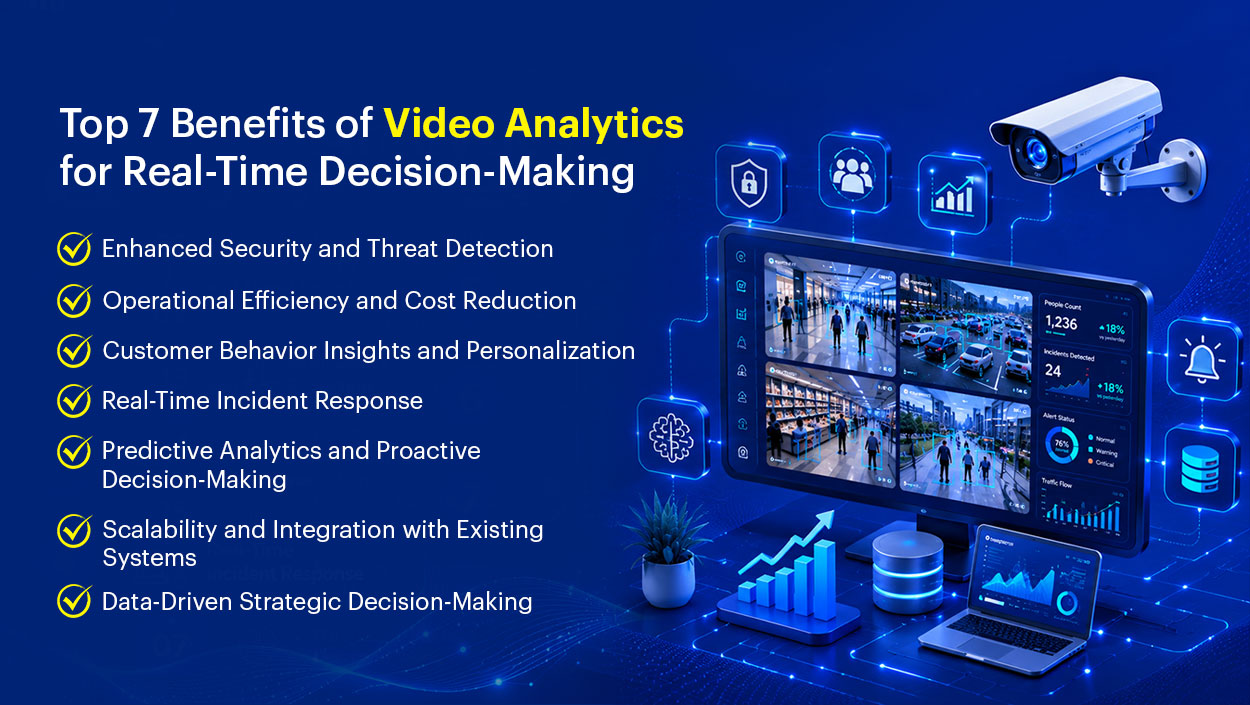
Video analytics technology has evolved from a nice-to-have feature to a business-critical capability. The top benefits are enhanced security, operational efficiency, customer insights, real-time incident response, predictive analytics, scalability, and data-driven strategic decision-making and delivering measurable ROI across industries.
With the market projected to reach USD 37.84 billion by 2030, organizations that delay adoption risk falling behind competitors who leverage these powerful insights. Whether you're a retailer optimising store layouts, an airport managing passenger flow, or a manufacturer ensuring safety compliance, video analytics solutions provide the real-time intelligence needed to make faster, smarter decisions
The technology is mature, the ROI is proven, and the market momentum is undeniable. Partner with an experienced AI consulting company to develop an implementation strategy tailored to your organisation's needs. Consider complementing your video analysis software with services for automated alert systems that ensure critical insights reach the right people instantly.
The future of business intelligence is visual, real-time, and powered by AI. Organizations that embrace video analytics today will be the leaders of tomorrow.
1. Can video analytics work effectively in low-light or nighttime conditions without additional infrastructure?
Yes, modern video analysis software uses advanced algorithms that examine captured videos frame by frame irrespective of light exposure, making it reliable for 24/7 security. Many enterprise-grade video analytics solutions now integrate thermal imaging and infrared capabilities directly into cameras, eliminating the need for separate night-vision infrastructure.
2. What's the actual ROI timeline for small-to-medium businesses implementing video analytics, and when do they typically see break-even?
While most enterprise case studies highlight Walmart and Heathrow Airport, smaller businesses typically see ROI within 8-14 months. The key difference is scale: SMEs achieve break-even faster through labour cost reduction (eliminating 1-2 monitoring positions) rather than revenue optimization. A manufacturing case study showed that phased deployment without disrupting operations enabled faster cost recovery.
3. How does video analytics handle privacy concerns and GDPR/compliance requirements when collecting customer behaviour data in real-time?
Modern video analytics solutions address privacy through three key mechanisms: First, on-edge processing that anonymises data before storage, Second automated blurring of faces/licence plates unless specific trigger events occur, and third, retention policies that automatically delete footage after 24-72 hours unless flagged.
4. Can existing old analogue CCTV cameras be upgraded for video analytics, or must I replace my entire camera infrastructure?
You don't need to replace your entire infrastructure. Most video analytics solutions can integrate with existing CCTV systems through video encoders that convert analogue signals to digital streams for AI processing. The deployment can be carried out without disrupting existing operations, making adoption easier for organizations with established security infrastructure
5. What happens if the video analytics system goes offline or loses internet connectivity, does real-time decision-making stop completely?
No, and this is where edge computing changes the game. Modern video analytics solutions with edge AI capabilities continue processing locally on the camera even during internet outages. Alerts and critical decisions happen in real-time at the edge, while cloud synchronisation occurs once connectivity resumes. Cloud deployment segments are growing at 24.6% CAGR, but hybrid edge-cloud architectures now dominate enterprise deployments.



Don’t Worry we are here to increase your business potential with our result-oriented solutions.
Leave a Comment
Your email address will not be published.