

We use cookies to ensure that we give you the best experience on our website.
By using this site, you agree to our use of cookies. Find out more.

 May 27, 2026
|
May 27, 2026
|
 |
|
 Robotic Process Automation
The conversation around enterprise automation has moved well beyond simple cost reduction. Today, leaders are using robotic automation to improve productivity, strengthen compliance, and support growth in fast-changing markets. This is especially true as companies combine automation with AI, cloud platforms, and process analytics to create more agile operating models.
For business teams, the appeal is practical: fewer manual errors, quicker turnaround times, better visibility, and more time for higher-value work. In 2026, the most successful organizations are treating automation as a strategic capability, not just an operational improvement.
Modern enterprises face rising complexity in finance, operations, customer service, supply chain, and technology support. Robotic process automation helps address that complexity by handling repetitive, rules-based tasks with speed and consistency. It also reduces dependency on manual intervention, which improves service quality and operational reliability.
Another major reason adoption is accelerating is the pressure to do more with leaner teams. Enterprises are using robotic automation to support growth without increasing overhead at the same pace. That makes it valuable in both mature markets and high-growth regions, such as robotic automation in india, where businesses are rapidly modernising back-office operations, IT services, and shared service functions.
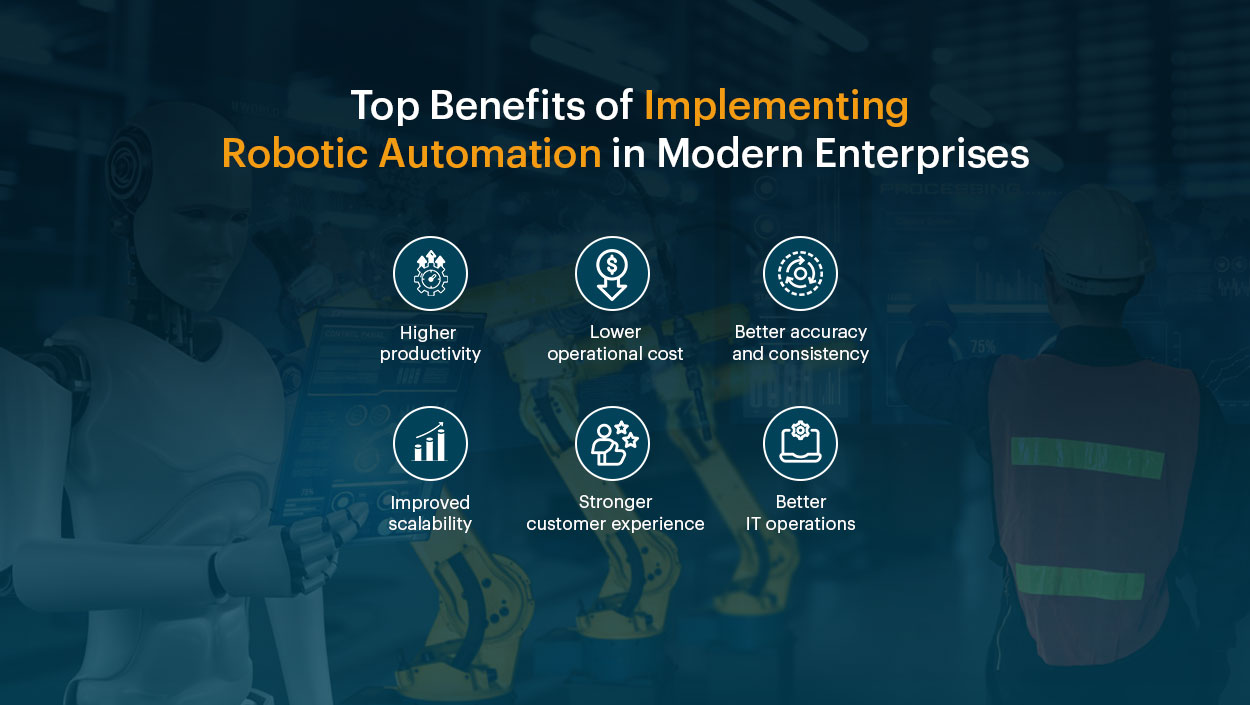
Automation keeps work moving without delays caused by manual handoffs. That means faster approvals, quicker data processing, and better throughput across critical workflows. When repetitive tasks are automated, teams can focus on exceptions, analysis, and decision-making.
One of the biggest advantages of robotic automation is its ability to reduce labour-intensive work and rework. By minimising errors and eliminating repetitive manual steps, enterprises can lower process costs over time. This creates a stronger return on investment than many traditional efficiency programs.
Manual work often introduces mistakes, especially in high-volume environments. Robotic process automation improves consistency by following the same rules every time. That matters in finance, compliance, procurement, customer onboarding, and reporting.
As business volume grows, automation allows enterprises to handle more work without proportional staffing increases. This is particularly useful for staffing solutions services, where candidate screening, onboarding, document collection, and status tracking can all be streamlined. It also helps service organizations scale faster during seasonal or project-driven demand.
Automation shortens response times and reduces service delays. In customer-facing functions, that leads to faster issue resolution, fewer backlogs, and better satisfaction. Enterprises can also use robotic automation to ensure service requests are routed correctly the first time.
In technology environments, automation can support monitoring, ticket routing, alert triage, and incident handling. This is especially useful in a Network Operations Center, where teams need to detect issues quickly and respond before outages spread. Automating repetitive monitoring tasks improves uptime and reduces alert fatigue.
These use cases deliver the most value when automation is applied to end-to-end workflows rather than isolated tasks. That is where robotic process automation becomes a true business enabler.
The biggest 2026 trend is the shift from simple task automation to intelligent automation powered by AI. Enterprises are increasingly blending robotic automation with machine learning, process mining, and AI assistants to improve decision-making. That combination is helping organizations automate not only execution but also parts of analysis and exception handling.
Another major trend is the growth of robotic automation in india, especially across IT services, business process operations, manufacturing, and global capability centers. India’s enterprise ecosystem is adopting automation to improve service quality, reduce turnaround times, and support global delivery models.
A third trend is the expansion of automation in technical operations, including the Network Operations Center. As infrastructure becomes more complex, automation is helping teams prioritise alerts, reduce manual escalations, and improve incident response. This is becoming essential for enterprises that rely on always-on digital services.
Many enterprises still operate with older platforms that do not connect easily. This can slow down automation projects and increase complexity. The best solution is to start with clearly defined processes and gradually extend automation where systems are stable.
Employees may worry that automation will replace jobs. In reality, the strongest programs use robotic automation to remove repetitive work and free people for higher-value tasks. Clear communication, training, and role redesign are essential for adoption.
As more processes become automated, enterprises need strong controls for access, approvals, and exception handling. This is especially important in finance, compliance, and staffing solutions services, where data quality and auditability matter. A solid governance model keeps automation scalable and trustworthy.
The rise of robotic automation in india is being driven by digital transformation, service export growth, and competitive pressure across industries. Indian enterprises are adopting robotic process automation to improve delivery speed, support enterprise clients, and standardize operations across locations. This is especially visible in IT services, BFSI, telecom, logistics, and shared service centers.
For businesses in India, automation is also a talent strategy. By automating routine tasks, companies can redirect skilled employees into analytics, customer support, process design, and higher-value service work. That creates a stronger long-term operating model.
Global brands are increasingly using robotic automation to streamline complex workflows, reduce manual effort, and improve visibility across operations. In large organizations, the biggest gains usually come from integrating automation with existing enterprise systems rather than trying to replace everything at once.
In the context of staffing and services, automation can speed up candidate screening, document verification, onboarding, and case tracking. In technical operations, a Network Operations Center can use automation to filter alerts, assign incidents, and accelerate response times. These are practical examples of how automation drives measurable impact across different parts of the business.

Robotic automation is no longer optional for enterprises that want to stay competitive in 2026. It improves productivity, lowers cost, strengthens compliance, and supports better service delivery across business functions. When combined with robotic process automation, it becomes a powerful foundation for scale, resilience, and digital transformation.
For organizations in India and beyond, the opportunity is clear: automate repetitive work, empower teams with better tools, and build smarter operations for the future. Businesses that invest now will be better positioned to grow, adapt, and lead.
1. What is robotic automation in enterprises?
It refers to using automated systems to perform repetitive, rules-based business tasks with speed and consistency.
2. How is robotic process automation different from robotic automation?
Robotic process automation usually focuses on software-based task automation, while robotic automation can also include broader operational and physical process automation.
3. Why is robotic automation in india growing quickly?
Because Indian businesses are under pressure to improve efficiency, scale services, and support global delivery with lower operating friction.
4. How can staffing solutions services benefit from automation?
They can automate resume screening, interview scheduling, onboarding, document checks, and candidate updates.
5. How does automation help a Network Operations Center?
It helps reduce alert noise, prioritise incidents, speed up routing, and improve response times.

Don’t Worry we are here to increase your business potential with our result-oriented solutions.


Leave a Comment
Your email address will not be published.