

We use cookies to ensure that we give you the best experience on our website.
By using this site, you agree to our use of cookies. Find out more.
 July 01, 2026
|
July 01, 2026
|
 |
|
 AI chatbot, Application Support and Maintenance, Mobile App Development
AI-native application development is moving from pilot projects to enterprise operating models, and the biggest winners will be the companies that redesign products, teams, and governance around intelligence from the start. In this long-form guide, I’ll cover what’s changing, where the market is heading, and how large organizations are using AI-native apps with the help of IT Outsourcing Services to improve speed, customer experience, and business performance.
The market is moving quickly from experimentation to operational scale. Industry commentary in 2026 suggests that AI-native apps are becoming more differentiated from the underlying models, with the app layer now seen as a durable competitive advantage because it controls workflow, context, and user experience. In parallel, Mobile app development commentary shows that organizations are compressing team structures and using agents to handle more of the repetitive build-test-review cycle, although the strongest gains come only after process redesign.
There is also a strong outsourcing and delivery angle. Recent industry material on mobile app outsourcing says enterprises are using external teams to accelerate development, lower costs, and access specialized talent, especially when the scope includes AI integration and cloud modernisation. That makes IT Outsourcing Services a practical accelerator for companies that need to move faster without rebuilding every capability internally.
AI-native applications are built around models, automation, and adaptive workflows rather than adding AI as an afterthought. That distinction matters because the latest industry discussion emphasises that real productivity gains show up when teams redesign the workflow itself, not when they simply bolt an assistant onto an old process. Andreessen Horowitz notes that AI apps are increasingly combining orchestration, domain-specific UX with IT Outsourcing Services, and large feature surfaces, which is exactly why enterprises are now treating AI-native development as a strategic capability rather than a side experiment.
For large enterprises, this shift is showing up in three places: internal productivity tools, customer-facing experiences, and operational systems that can learn and respond in real time. The result is not just faster software delivery but also smarter software that can adapt to business conditions more quickly than traditional applications.
The timing is being driven by a mix of model maturity, platform readiness, and executive pressure to do more with less. A 2026 field report on AI-native development argues that the real gains appear when teams redesign workflows around agents because shallow adoption often produces only limited improvements. The same report also points out that mature engineering environments benefit more than weaker ones, which means AI-native success depends heavily on engineering discipline, governance, and platform quality.
The business case is also broadening. Large organizations are now expecting AI to support planning, code generation, customer service, analytics, and decision support across departments, not just in isolated innovation labs. That is why interest in Mobile app development and connected enterprise platforms is rising alongside broader AI transformation efforts.
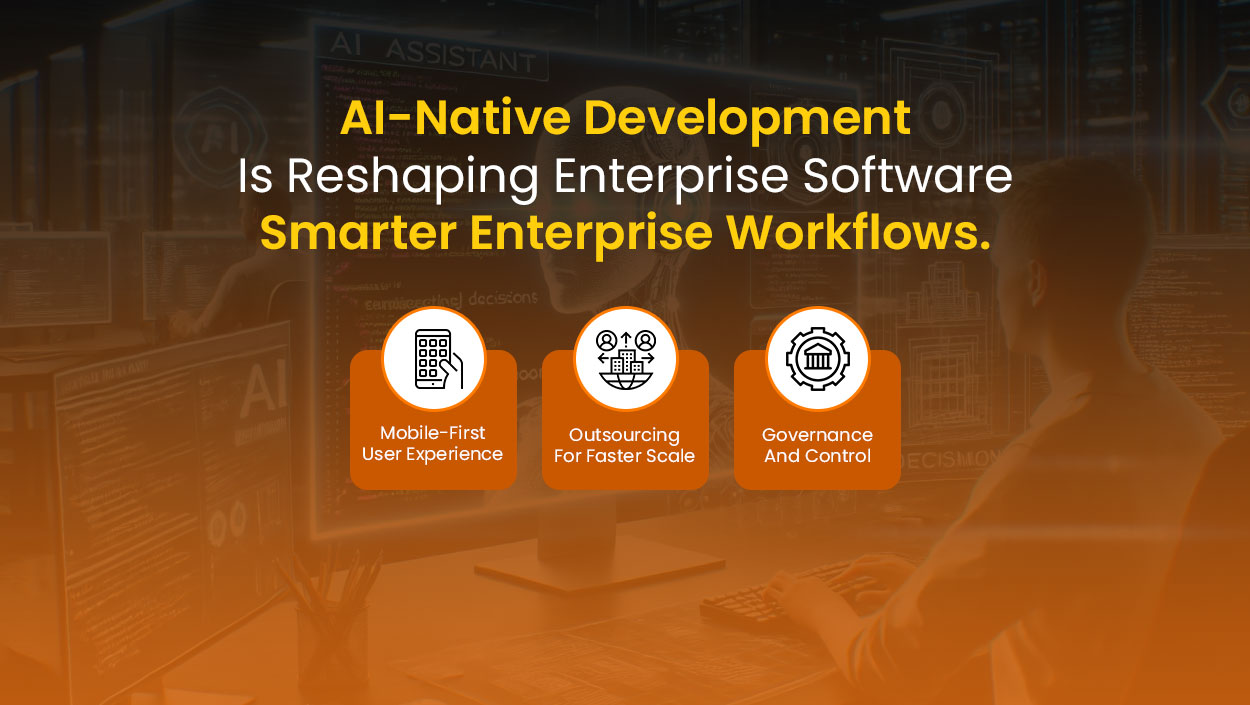
Smarter Enterprise Workflows
Enterprises are moving from static applications to AI-native systems that learn, adapt, and automate decisions in real time. This shift improves productivity, reduces manual effort, and helps teams respond faster to changing business needs.
Mobile-First User Experience
AI-powered mobile interfaces improve customer engagement and employee productivity across departments, locations, and workflows. Modern Mobile app development now focuses on intelligence, personalisation, and real-time decision support.
Outsourcing For Faster Scale
Businesses are pairing internal strategy with IT Outsourcing Services to accelerate delivery and access specialized AI talent. Outsourced teams help enterprises build, test, and scale AI-native applications without slowing internal operations. This approach reduces costs while improving speed, flexibility, and technical depth.
Governance And Control
The biggest advantage comes from redesigning workflows around AI instead of simply adding AI features to old systems. Strong governance is essential to manage data quality, security, compliance, and human oversight. Enterprises that balance automation with control are better positioned to scale AI safely and effectively.
Business Use Cases
AI-native applications are showing up in a wide range of enterprise use cases. In customer support, they can route tickets, draft responses, and escalate edge cases with more context than rule-based systems. In finance and operations, they can monitor anomalies, predict demand shifts, and assist with forecasting. In product and engineering, they can generate tests, summarise issues, and help teams ship faster with less manual overhead.
Mobile is especially important because it is where many employees and customers actually experience the value. AI-aware mobile apps can personalise content, surface next-best actions, automate routine updates, and support real-time decision-making on the move. That is why Mobile app development is increasingly being treated as the front door to enterprise AI adoption rather than a separate channel.
Microsoft s 2025 Build case studies show how agentic workflows are moving into production across governance, customer experience, and financial services. One example highlighted governance agents powered by Azure AI Foundry, designed to streamline corporate governance tasks and improve operational efficiency. The broader lesson is that large enterprises are no longer asking whether AI can help; they are asking where agentic workflows can remove friction from high-volume processes.
The implementation strategy here is notable because it centers on platform integration rather than one-off demos. Microsoft s examples point to workflows built on enterprise-grade infrastructure, which helps with security, scale, and reuse. The key lesson is that AI-native success depends on embedding intelligence into the workflow layer, not just offering a chatbot on top of existing systems.
A European banking case study from Appinventiv shows how an enterprise deployed an AI chatbot in web and mobile apps across seven languages to handle customer complaints and stolen-card cases in real time. The same engagement also used machine learning to predict churn, support ATM cash forecasting, and connect AI outputs through APIs into the bank s CRM. Reported results included reducing manual processes by 35%, improving accuracy by 50%, and handling more than 50% of customer service requests through chatbot workflows.
The strategy was important because it combined customer experience with operational efficiency. Instead of using AI only as a support tool, the bank applied it across front-office and back-office functions, which improved retention and service levels at the same time. The main lesson is that AI-native value compounds when mobile interfaces, CRM data, and workflow automation are connected through a coherent architecture.
Expert commentary in 2026 increasingly agrees on one central point: AI-native apps work best when teams redesign the operating model around them. A major field report argues that the best teams use agents for code, tests, reviews, deploys, and documentation while humans retain context, architecture, and signoff. Andreessen Horowitz adds that enterprises should think of software as a company-wide operating layer, not just an engineering function, because AI is making every function more software-driven.
That perspective matters for enterprise leaders because it changes the questions they ask. Instead of How do we add AI to this app? the better question is Which workflows should be rebuilt around intelligence, and which teams need a new operating model to support that?
For many organizations, the fastest path to AI-native delivery is a hybrid model. Internal teams usually own strategy, data governance, and core product decisions, while external specialists help with architecture, implementation, integration, and scaling. That is where IT Outsourcing Services can be especially valuable, because they bring ready-made delivery patterns for cloud, mobile, testing, and AI integration.
This model works best when vendors are treated as transformation partners rather than just capacity suppliers. Enterprises should look for outsourcing teams that understand model integration, secure data handling, API orchestration, and mobile-first user experience. In practice, this often shortens time to market and helps companies test multiple AI-native use cases before committing to a full-scale rollout.
AI-native development is not risk-free. The more autonomy you give systems, the more important governance becomes. The 2026 field report warns that AI is an amplifier: strong teams get stronger, while weak process discipline can produce bad outcomes faster. That means enterprises need controls for data quality, privacy, auditability, and approval boundaries before they scale AI agents into production.
Leaders also need to think carefully about human oversight, especially for irreversible actions and customer-impacting decisions. In practice, the safest model is to let AI prepare and recommend while humans approve high-risk operations. That balance preserves speed while reducing the chance of costly mistakes.
The rise of AI-native application development is changing how large enterprises build, deploy, and scale software. The most successful organizations will not simply add AI features; they will redesign products, workflows, and teams so intelligence is part of the foundation. That is why the combination of mobile app development and IT Outsourcing Services has become such an important execution path: it connects enterprise strategy to user-facing delivery at speed.
As AI-native systems mature, the winners will be the companies that invest in architecture, governance, and cross-functional execution early. The opportunity is no longer theoretical; it is already visible in production cases across governance, banking, customer experience, and enterprise productivity.

Don’t Worry we are here to increase your business potential with our result-oriented solutions.


Leave a Comment
Your email address will not be published.