

We use cookies to ensure that we give you the best experience on our website.
By using this site, you agree to our use of cookies. Find out more.
 July 09, 2026
|
July 09, 2026
|
 |
|
 Video Analytics
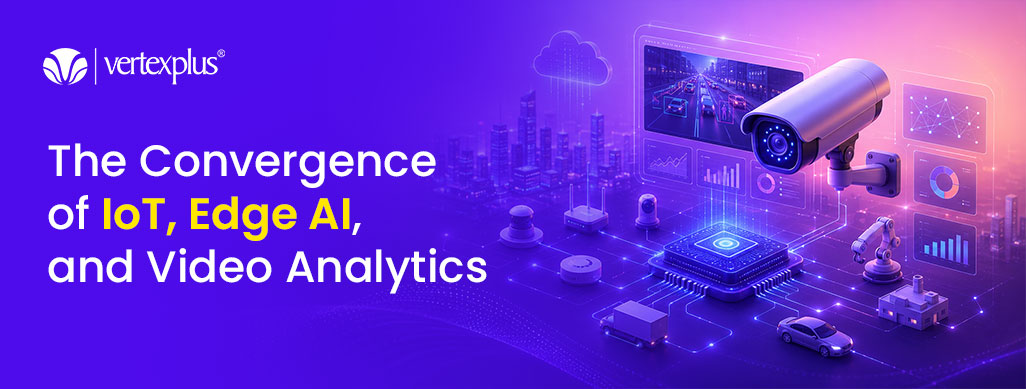
Connected cameras, sensors, and edge devices are changing how organizations monitor physical spaces. When IoT feeds are combined with edge AI and video surveillance analytics software, video becomes a live operational signal rather than a passive recording. This shift is especially valuable in environments where latency, bandwidth, and reliability matter.
The result is a new model for enterprise visibility. Organizations can detect incidents, trigger alerts, and correlate video with other sensor data without waiting for centralised processing.
Traditional video systems often struggle with delay, cloud cost, and bandwidth pressure. Edge AI solves much of that by running inference locally, while IoT provides additional context from motion sensors, access controls, environmental monitors, and machine telemetry. Together, these systems create a more complete view of what is happening in real time.
This is why the market is moving toward distributed intelligence. A recent market estimate projects the video analytics market at USD 13.67 billion in 2026 and USD 61.18 billion by 2035, reflecting strong long-term demand for smarter visual intelligence. Another forecast says the video analytics market will grow from USD 14.65 billion in 2026 to USD 41.39 billion by 2031.
At a practical level, IoT devices capture signals, edge AI analyses them locally, and video analytics turns camera feeds into usable events, summaries, and alerts. The local processing layer reduces response time and lowers dependence on always-on cloud connectivity. The cloud then supports storage, model updates, reporting, and enterprise dashboards.
This architecture is especially useful for Network Operation Center teams that need immediate visibility into distributed locations. It also supports hybrid monitoring models where incidents are flagged at the edge but reviewed centrally for compliance or escalation.
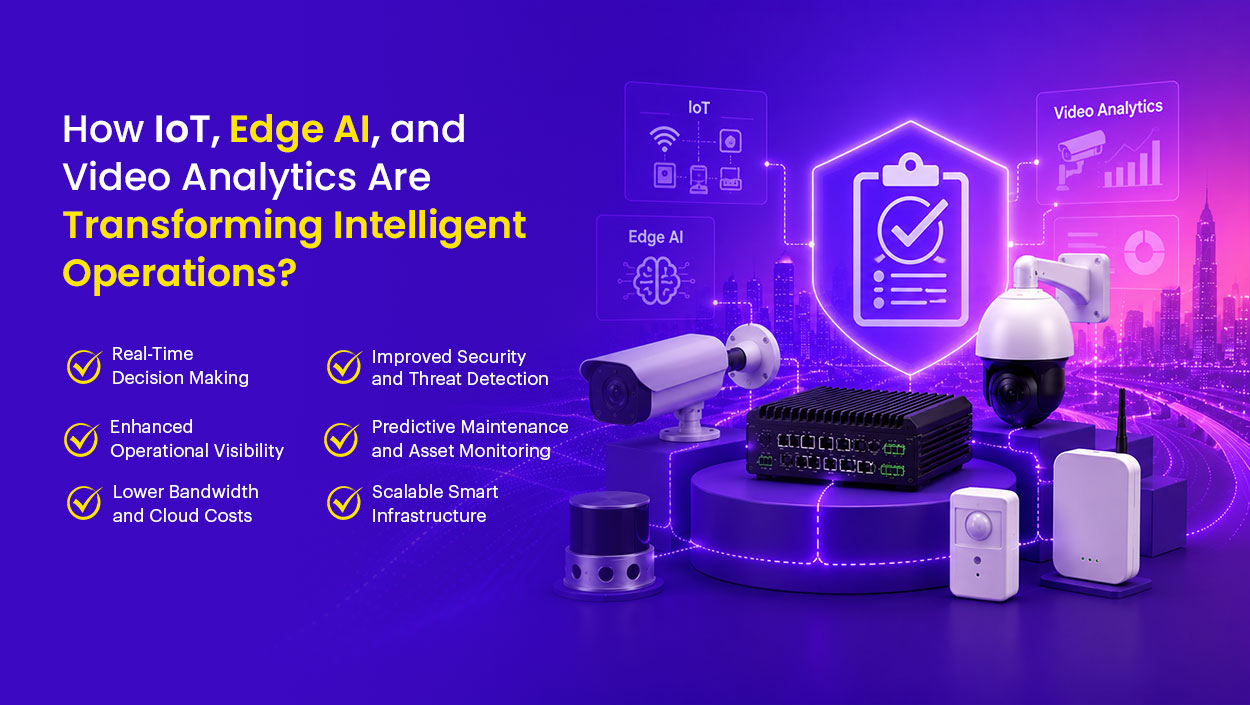
Real-Time Decision Making
Edge AI processes video data locally, while IoT devices provide contextual information, enabling organizations to detect incidents instantly, automate responses, and reduce delays caused by cloud-based processing.
Enhanced Operational Visibility
Combining video analytics, IoT sensors, and Edge AI creates a unified ecosystem that delivers deeper insights into equipment, people, and environments for faster, data-driven operational decisions.
Lower Bandwidth and Cloud Costs
Processing video at the edge minimizes unnecessary data transmission to the cloud, reducing bandwidth usage, lowering storage expenses, and improving the efficiency of enterprise-scale surveillance systems.
Improved Security and Threat Detection
Intelligent cameras integrated with IoT access controls and Edge AI can identify suspicious activities, trigger real-time alerts, and enhance security across campuses, factories, retail stores, and smart cities.
Predictive Maintenance and Asset Monitoring
Video analytics combined with IoT machine telemetry helps monitor equipment health, detect anomalies early, and schedule maintenance proactively, minimising downtime and extending the lifespan of critical assets.
Scalable Smart Infrastructure
The convergence of IoT, Edge AI, and video analytics supports scalable deployments across manufacturing, healthcare, transportation, logistics, and smart cities while maintaining high performance and low latency.
The strongest use cases appear where speed and context are both important. In retail, the system can connect shelf video with footfall sensors and checkout data. In manufacturing, it can combine machine telemetry with camera feeds to detect unsafe behaviour or equipment issues.
In logistics and smart facilities, edge-enabled video systems can detect congestion, access violations, or process breakdowns in real time. In hospitality, they can help monitor guest flow, service bottlenecks, and perimeter safety with far less manual review.
This is also driving demand for data annotation services because organizations need labelled footage to train and refine models for specific environments. The more specialized the use case, the more valuable domain-specific annotation becomes.
Case Study: Microsoft Azure IoT Edge
Microsoft has demonstrated how live video analytics can run on IoT Edge, and, of course, Network Operation Center is using AI extensibility and custom model deployment. Its training materials describe a workflow where a YOLO model is deployed as a container on an edge device to detect a person on a factory floor. The solution is designed to process simulated live video locally and integrate with Azure resources for orchestration and validation.
The implementation strategy is important because it shows how enterprises can keep inference close to the camera while still benefiting from cloud management. The lesson is that edge architectures work best when they are containerised, modular, and easy to deploy across many sites.
Case Study: Smart Doorbell Framework
A distributed research framework presented at ACM shows how video analytics can be orchestrated across edge and cloud resources for IoT-based smart doorbells. The study evaluated trade-offs across accuracy, latency, memory, and CPU usage and found that AWS-based edge-cloud orchestration achieved good detection accuracy with low resource usage, though latency remained higher than some alternatives.
The lesson here is that not every workload should be fully cloud-based. For privacy-sensitive and latency-sensitive applications, edge AI can reduce overhead and improve responsiveness while still supporting scalable analytics.
A successful rollout should begin with one high-value site and one measurable goal. That might be reducing incident response time, improving safety compliance, or lowering manual monitoring effort. The right pilot should include camera feeds, sensor inputs, alert rules, and a review workflow.
Enterprises should also align stakeholders early. Operations, security, IT, and analytics teams must agree on data flow, access control, and escalation logic. That is where a mature Network Operation Center can become the coordination hub for distributed video intelligence.
Key Challenges
Despite the benefits, convergence creates new operational challenges. More edge devices mean more endpoints to secure, update, and monitor. Data quality also becomes critical, especially when models depend on accurate data annotation services to adapt to local conditions.
There are also governance concerns. Teams need clear policies for retention, privacy, model drift, and human review. The strongest deployments combine automation with oversight rather than trying to replace operators entirely.
Organizations that connect IoT, edge AI, and video analytics gain faster detection, lower bandwidth usage, and better situational awareness. They can also respond to events earlier, before problems cascade into safety, quality, or customer experience issues.
The business value is not just technical. It is operational. Businesses get better decisions, more efficient monitoring, and a stronger foundation for scaling intelligent environments across locations.
1. Why is edge AI important in IoT-based video analytics?
Edge AI reduces latency by processing footage near the camera, which is crucial when quick decisions are needed for security, safety, or operations.
2. How does IoT improve video analytics outcomes?
IoT adds context from sensors such as motion, temperature, access control, and machine data, making video alerts more accurate and actionable.
3. What role does a Network Operation Center play here?
A Network Operation Center centralizes monitoring, incident review, and escalation while edge systems handle local detection and response.
4. Why are data annotation services still needed if AI is running at the edge?
Edge AI still needs labeled examples to improve accuracy, adapt to new environments, and reduce false positives in specialized use cases.
5. Which industries benefit most from this convergence?
Retail, manufacturing, logistics, transportation, hospitality, and critical infrastructure benefit most because they rely on fast visual decision-making across many sites.

Don’t Worry we are here to increase your business potential with our result-oriented solutions.


Leave a Comment
Your email address will not be published.