

We use cookies to ensure that we give you the best experience on our website.
By using this site, you agree to our use of cookies. Find out more.
 April 16, 2026
|
April 16, 2026
|
 |
|
 Data Annotation
Artificial Intelligence is evolving fast, and it's creating a major impact on the technology and regular functioning of the data-related services. One key thing that makes AI models work well is data annotation. Whether it's for computer vision systems, video analytics solution or conversational AI through an AI chatbot development company good annotated data is essential.
Data annotation is when we label data like images, text, video, and audio. This helps machine learning models understand patterns and make predictions. Without labels, AI systems can't learn well. This blog looks at the differences, benefits, tools, and strategies for choosing between manual and AI-based annotation.
Data annotation is adding labels to data. This helps AI and machine learning models understand the information. Annotated data trains algorithms for applications like vehicles, voice assistants, video analytics platforms, chatbots, image recognition systems, and natural language processing tools.
Data annotation services work with data formats like text, images, video, and audio. These annotations help AI systems recognize objects, understand language, and detect patterns.
For example, image annotation labels objects in pictures. Text annotation identifies sentiment or entities. Video annotation tracks objects across frames. Audio annotation tags speech patterns. As AI adoption grows, the need for accurate annotation solutions has increased.
Manual data annotation involves annotators labeling data manually. Teams of experts review images, videos, or text and assign labels. This method is traditionally used by AI development teams and outsourced vendors providing data annotation services.
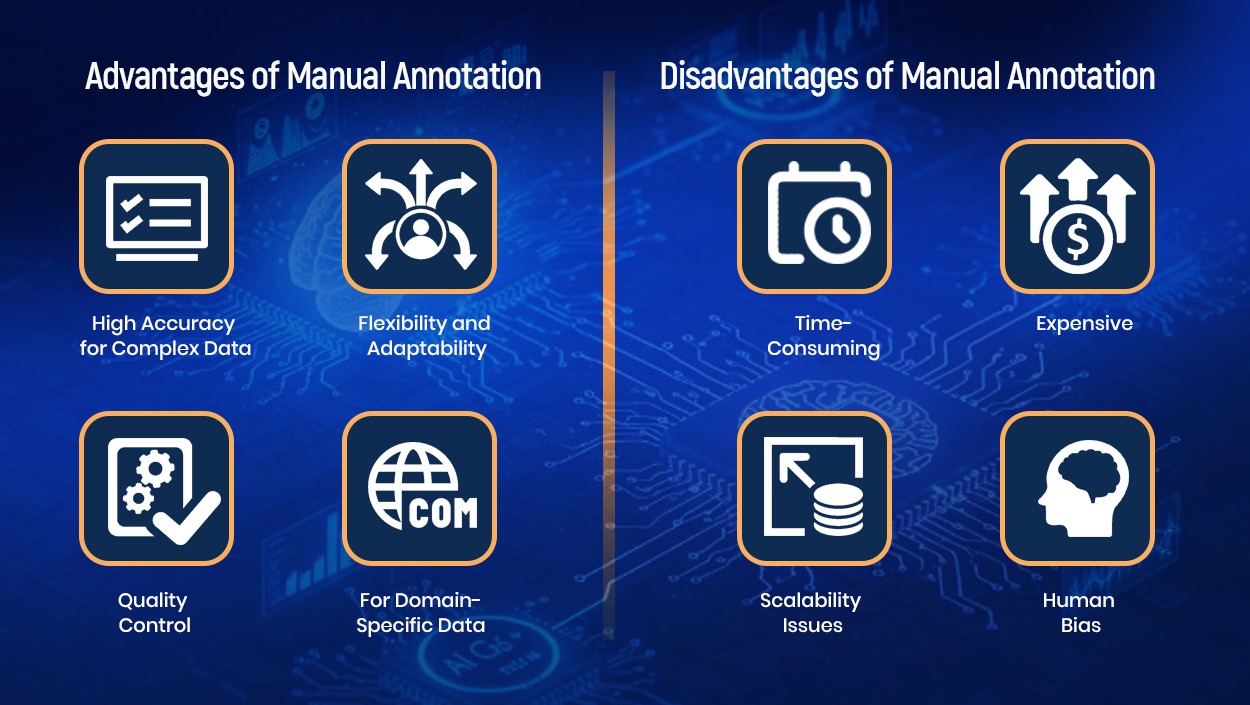
GIven below are the advantages of manual annotation explained in detail:
Humans understand context and domain details better than machines. This is useful for image annotation, legal document analysis, and advanced natural language processing tasks.
Human annotators adapt quickly when project requirements change or new categories need to be added.
Manual workflows often include validation layers like peer review and quality audits. This ensures high-quality training data for AI models.
Industries like healthcare, finance, and cybersecurity require subject-matter experts to label datasets accurately.
GIven below are the disadvantages of manual annotation explained in detail:
Manual labelling takes weeks or months for datasets to function properly.
Human annotators require salaries, training and management, making large-scale projects costly.
Manual teams struggle with the amount of data generated today, and it is a major drawback.
Annotators may introduce bias into datasets, affecting AI outcomes, and it becomes difficult.
AI annotation tools use machine learning algorithms to label data. These tools process millions of data points quickly. Many modern annotation platforms use semiautomated or AI-assisted labelling techniques. For example, object detection models label images. Natural language processing models classify text automatically.
GIven below are the advantages of data annotation tools explained in detail:
Powered tools analyse thousands or millions of data points quickly, reducing annotation time. This is useful for video analytics solution platforms.
Automated annotation systems scale when datasets grow.
Automated tools reduce labour costs by minimising the need for annotation teams.
Algorithms follow predefined rules and labelling standards, ensuring annotations.
GIven below are the disadvantages of automated annotation explained in detail:
AI tools may misinterpret data or domain-specific context.
Automated annotation systems require high-quality training datasets.
Algorithms must be retrained when requirements change.
Even automated pipelines require review to verify results and correct errors.
Given below are the manual vs AI annotations explained in detail:
Factor | Manual Annotation | AI-Based Annotation |
| Speed | Manual annotation is slower. | AI-based annotation is fast. |
| Accuracy | Manual annotation is better for tasks. | Automated tools provide moderate accuracy. |
| Cost | Manual annotation is more expensive. | Automation reduces long-term costs. |
Scalability | Manual teams have limitations. | AI-Based Annotation don’t have limitations. |
| Flexibility | Human annotators adapt quickly to changes. | AI systems require retraining. |
Several industries need data annotation services.
Self-driving cars rely on annotated video and image data.
Powered recommendation systems require annotated customer data and product images.
Imaging AI models rely on accurately labelled X-rays, MRI scans and CT scans.
Organizations use video analytics solution platforms that require footage.
Companies working with AI chatbot development require annotated conversational datasets.
Annotation projects need expert guidance from AI Consulting Services. AI consultants help organizations select the right annotation tools and build pipelines. Companies expanding AI teams rely on IT recruitment for GCC to hire skilled AI engineers, data scientists and annotation specialists.
AI-assisted annotation will allow machine learning models to label datasets. Active learning will help AI models identify data points requiring human review.
The best approach depends on project requirements. Manual annotation works best for data, domain expertise, accuracy, or small datasets. AI annotation is ideal for datasets, speed, repetitive tasks, and scalability. The effective strategy today is a hybrid model that combines AI automation with human expertise.
Data annotation is key to AI models. Whether companies develop computer vision systems, launch a video analytics solution or build intelligent chatbots with an AI chatbot development company, good annotated data is essential.
FAQs
1. What are data annotation services?
Data annotation services involve labelling datasets, like images, text, audio or videos, so AI and machine learning models can understand patterns and make predictions.
2. What is the difference between manual and automated annotation?
The main difference is that manual annotation is done by people, while automated annotation uses computers to label data. Manual annotation is when human experts label data themselves. Automated annotation uses computer tools to label data automatically.
3. Why is data annotation important for AI?
Data annotation is key for AI because machine learning models need labelled data to learn. If the data is not labelled correctly, the AI models will not be able to make predictions.
4. What industries rely heavily on data annotation?
Some industries that really need data annotation are autonomous vehicles, healthcare, retail, security, and conversational AI. These industries rely heavily on data to train their AI models.
5. How do AI consulting services help in data annotation projects?
AI consulting services help businesses in many ways; they help select the right tools for annotation. They design a workflow that works well. They make sure the data is of quality for training AI models.



Don’t Worry we are here to increase your business potential with our result-oriented solutions.
Leave a Comment
Your email address will not be published.