

We use cookies to ensure that we give you the best experience on our website.
By using this site, you agree to our use of cookies. Find out more.
 April 30, 2026
|
April 30, 2026
|
 |
|
 Data Annotation
Artificial Intelligence is only as good as the data it uses. High-quality data with labels is very important for training reliable AI models. This is where data annotation services and tools come into play. Picking the data annotation tools can directly affect your project's efficiency, how well it scales, and how well it does overall.
Whether you are working on computer vision, natural language processing, or video analytics, picking the solution is not just a technical decision. It is a strategic one. In this blog you will explore how to pick the data annotation tools for your AI project while keeping your business goals in mind.
Data annotation is the process of labeling data, like images, text, audio, or video, to make it understandable for machine learning models. Without annotation, even the most advanced algorithms fail to deliver accurate results, even with data annotation tools.
Using the data annotation tools ensures high-quality labeled datasets, faster project turnaround, reduced manual effort, improved AI model accuracy, and smooth integration with workflows like AI chatbot development and analytics systems.
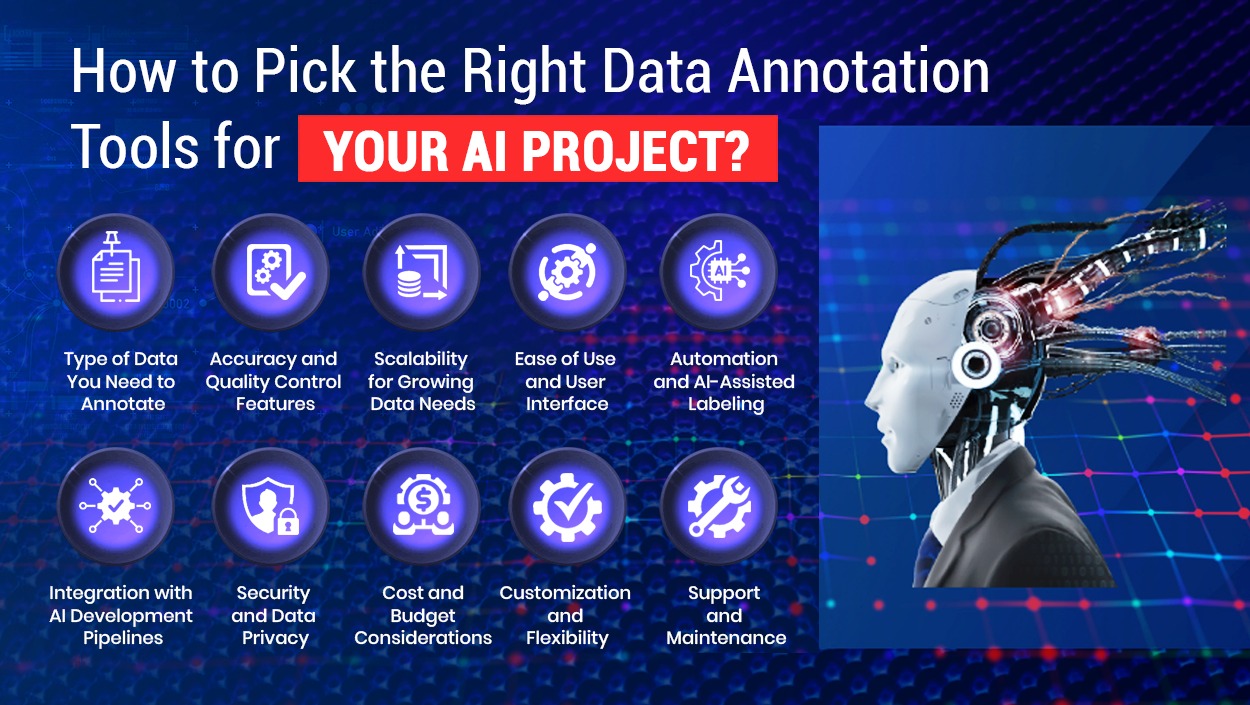
GIven below are the key factors to consider to choose the right data annotation tools for your AI project.
First you need to figure out what kind of data your AI project involves. Different tools specialize in formats, such as image annotation, text annotation, audio annotation, and video annotation. Pick a tool that supports your data type and offers features specific to your use case.
Accuracy is very important in any AI project. Poor annotation leads to ineffective models. Look for tools that provide high-level quality checks, automated validation systems, annotation guidelines enforcement and human-in-the-loop review processes. Professional data annotation services often include quality assurance layers that improve consistency across datasets.
AI projects often start small. Grow rapidly. Your chosen tool should be able to scale with your data requirements. Important scalability features include cloud-based infrastructure, bulk annotation capabilities, distributed workforce support, and automation for tasks.
A complex tool can slow down your annotation process. Look for data annotation tools with dashboards, easy navigation, minimal training requirements and customisable workflows. A user-friendly interface ensures onboarding and improved productivity for your annotation team.
Modern annotation tools offer AI features that significantly reduce manual work. These include pre-using machine learning models, auto-segmentation for images and smart suggestions for text annotation. These capabilities are especially useful for projects like video analytics and AI chatbot development, where large volumes of data need to be processed.
Your annotation tool should seamlessly integrate with your AI ecosystem. Check for compatibility with machine learning frameworks, data storage systems, APIs for automation and model training pipelines. This ensures a workflow from annotation to deployment.
Data security is a concern, especially when dealing with sensitive information. Pick data annotation tools that offer data encryption, role-based access control, compliance with regulations, and secure cloud storage. Reliable data annotation services prioritise data protection while maintaining efficiency.
While cost should not be the factor, it plays an important role in decision-making. Evaluate pricing models, hidden costs, and ROI in terms of productivity and accuracy. Balancing cost with features ensures you get value from your investment.
Every AI project has requirements. The ideal tool should allow customisation, such as custom labelling of categories, workflow configuration, annotation guidelines, and role assignments. Flexible data annotation tools adapt to industries and use cases.
Technical support can save time. Prevent disruptions. Look for 24/7 customer support, documentation and training resources, and regular updates and feature improvements. A strong support system ensures long-term success for your AI initiatives.
Image and video annotation tools are widely used in vehicles, surveillance systems, retail analytics and healthcare imaging. These applications heavily rely on labelling for object detection and recognition.
Text annotation is essential for chatbots, sentiment analysis, language translation and virtual assistants. Efficient data annotation services enable the development of conversational AI systems like AI chatbot development.
With the rise of surveillance and media platforms, video analytics has become a major application area. Annotation tools help in object tracking, event detection, behaviour analysis, and motion recognition. Picking tools with video capabilities is crucial for such projects.
Given below are the common mistakes that you can avoid:
Picking the data annotation tools provides improved model accuracy, faster project completion, reduced operational costs, better scalability, and enhanced team productivity. When combined with data annotation services, businesses can accelerate their AI initiatives and achieve better results.
The field of data annotation is evolving rapidly with advancements in AI. AI-assisted annotation is becoming standard, synthetic data usage is increasing, and real-time annotation for streaming data is gaining traction. There is also a growing demand for tools for video analytics and deeper integration with advanced systems like AI chatbot development.
Picking the data annotation tools is a critical step in building successful AI projects. From understanding your data type to ensuring scalability, security and integration, every factor plays a role in your decision.
By using data annotation services, businesses can improve data quality, accelerate development, and achieve better AI outcomes. Whether your focus is on video analytics or AI chatbot development, the right tools will set the foundation for success.
1. How do I Determine Whether to Use In-House Annotation or Outsource Data Annotation Services?
If your project requires domain expertise, scalability, and faster turnaround, outsourcing is ideal. In-house annotation works better for projects with strict data control requirements.
2. Can One Tool Handle Multiple Types of Annotation, Like Text, Image, and Video Analytics?
Yes, some advanced data annotation tools support format annotation, but specialized tools often deliver better accuracy for specific data types.
3. How do Annotation Tools Impact the Performance of AI Chatbot Development Projects?
They ensure quality labelled conversational data, which improves intent recognition, response accuracy, and overall chatbot performance.
4. What Role Does Automation Play in Modern Data Annotation Services?
Automation reduces effort by pre-labelling data, speeding up workflows, and improving consistency across large datasets.
5. How Often Should Annotated Data be Reviewed for Quality?
Data should be reviewed continuously through level-quality checks, especially during large-scale projects, to maintain accuracy and consistency.

Don’t Worry we are here to increase your business potential with our result-oriented solutions.


Leave a Comment
Your email address will not be published.