

We use cookies to ensure that we give you the best experience on our website.
By using this site, you agree to our use of cookies. Find out more.
 June 18, 2026
|
June 18, 2026
|
 |
|
 Cyber Security
The era of borderless cloud computing has officially ended. In 2026, over 83% of companies now view sovereign AI as at least moderately important to their strategic planning, fundamentally changing how global enterprises manage data. What was once a niche government concern has become a critical business imperative, forcing multinational corporations to redesign their entire AI infrastructure around national boundaries with cybersecurity service options.
Sovereign AI refers to designing, training, and deploying AI systems that comply with national laws using domestic infrastructure and locally governed data. This shift is driving a $100 billion global investment in sovereign AI compute in 2026, with enterprises racing to reduce reliance on foreign AI capabilities. The consequences are profound: 77% of companies now factor an AI solution's country of origin into vendor selection, while 58% build AI stacks primarily with local vendors.
Beyond Data Residency: The Three Pillars of Modern Sovereignty
Sovereign AI goes far beyond simply storing data in a specific country. Enterprises must address three distinct layers of control to achieve true sovereignty in 2026:
The dream of a single, global AI architecture is colliding with geopolitical reality. By 2028, 60% of multinational firms will split AI stacks across sovereign zones, tripling integration costs as regulatory fragmentation slows strategic scaling. IDC predicts costs will triple as enterprises operate parallel environments with expensive middleware and governance layers to prevent data "leaks" across borders.
Sovereign Cloud Spending Surge
Global sovereign cloud spend will increase 35.6% to $80 billion in 2026 as geopolitical tensions drive organizations to retain full data control. A recent 2026 survey found that 51% of enterprises are shifting to a "Hybrid-Sovereign" model, keeping sensitive records in local sovereign clouds while using global clouds for non-sensitive workloads.
Regional Sovereignty Variations
Sovereignty concerns vary dramatically by region:
The "Cloud Boomerang" Effect
Companies that went all-in on global public clouds are pulling specific workloads back, a trend called 'Geopatriation'. The cost of a single compliance breach in 2026 fines now reaching 5% of global turnover, far outweighs centralised database convenience.
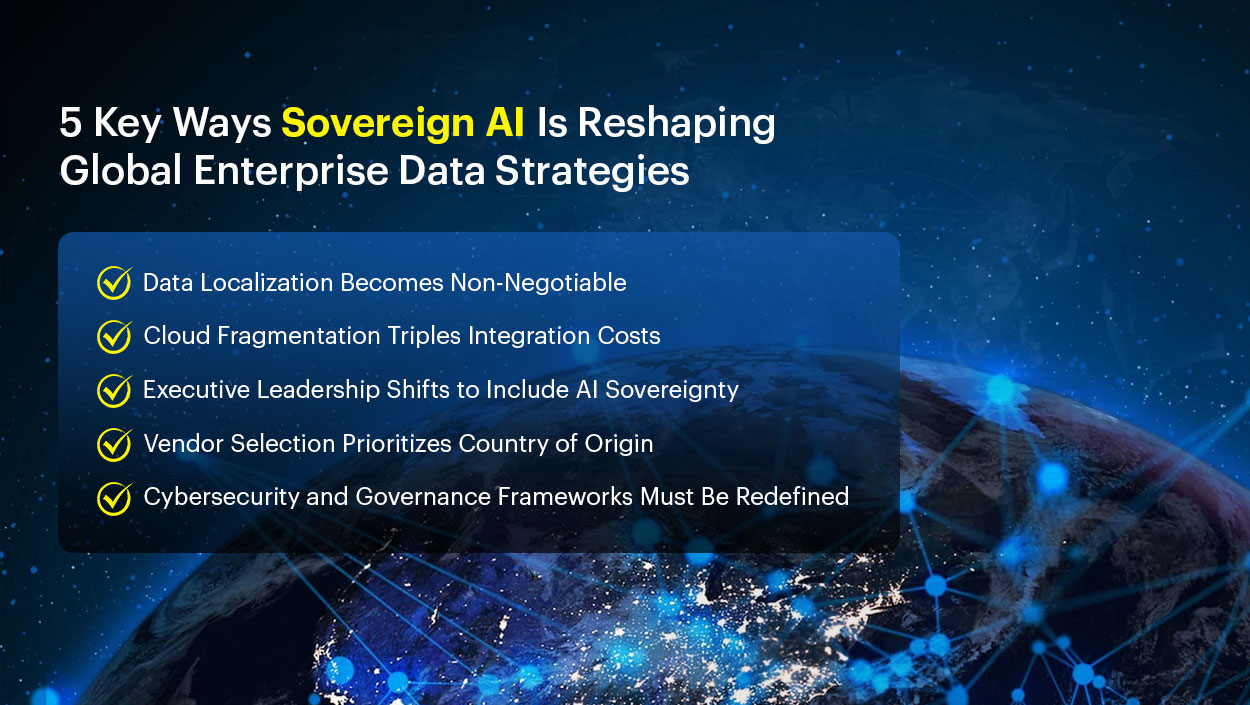
1. Data Localization Becomes Non-Negotiable
Enterprises must now store and process data within national borders to comply with sovereign AI requirements with Cybersecurity service,. Over 140 countries now have data protection laws mandating that sensitive data (customer PII, financial records, and health information) stay on domestic soil, forcing multinational companies to build parallel data infrastructure across sovereign zones instead of using centralised global clouds.
2. Cloud Fragmentation Triples Integration Costs
By 2028, 60% of multinational firms will split AI stacks across sovereign zones, tripling integration costs as regulatory fragmentation forces enterprises to operate multiple environments with expensive middleware and governance layers with cybersecurity service options to prevent data "leaks" across borders. This fragmentation means companies can no longer rely on single-vendor global cloud solutions.
3. Executive Leadership Shifts to Include AI Sovereignty
34% of Fortune 500 companies now have Chief AI Officers (CAIOs) reporting directly to the CEO or board, with AI sovereignty becoming a C-level priority rather than just an IT concern. Companies with dedicated AI leadership implements sovereign AI 67% faster and achieves 2.3x higher success rates than those treating it as a technical initiative.
4. Vendor Selection Prioritizes Country of Origin
77% of companies now factor an AI solution's country of origin into vendor selection, while 58% build AI stacks primarily with local vendors to reduce reliance on foreign enterprises for AI capabilities. This "geopatriation" trend is pulling workloads back from global public clouds to local sovereign infrastructure with cloud optimisation, creating an $80 billion sovereign cloud market in 2026.
5. Cybersecurity and Governance Frameworks Must Be Redefined
Sovereign AI requires human-in-the-loop governance as the standard operating model, with only 21% of organizations having mature governance models for autonomous agents. Enterprises must implement cybersecurity service frameworks that protect against AI-powered threats while maintaining compliance with local regulations, including zero data retention policies and private cloud deployment for sensitive workloads.
Financial Services: The First Movers
Financial institutions are moving transaction data to local sovereign vaults to meet new "Digital Trust" mandates. The Bank of Korea launched the world's first central bank sovereign AI system (BOKI) in January 2026, operating entirely within the central bank's internal network. BOKI processes 1.4 million standardised documents for research, compliance, and data analytics without external dependence.
Healthcare: Bio-Privacy Compliance
Healthcare organizations are storing patient biometrics locally to comply with strict 2026 bioprivacy laws. The sensitivity of medical data makes sovereign AI essential for maintaining patient trust and regulatory compliance.
Public Sector: Mandatory Sovereignty
Government agencies now exclusively mandate Sovereign Cloud for any contract involving citizen data. This sets a precedent that private enterprises must follow when handling similar sensitive information.
Implementation Strategy
In May 2026, Deutsche Telekom and SAP won a major tender to build a sovereign AI platform for the German Federal Government, marking a watershed moment in European digital sovereignty. The platform represents the cornerstone of the “Germany Stack” a shared digital infrastructure for the federal government, states, and municipalities. The Munich Industrial AI Cloud, launching in Q1 2026, transforms how businesses securely deploy AI solutions complying with local regulations
Key architectural decisions:
| Component | Implementation |
| Infrastructure | Deutsche Telekom's sovereign German T Cloud Public with NVIDIA Blackwell GPUs |
| Technology Layer | SAP Business Technology Platform + SAP Business AI Platform |
| Data Processing | Exclusively within Europe's legal framework |
| First Application | KIPITZ AI assistant for intelligent document processing, knowledge management, translations |
Results Achieved
| Metric | Impact |
| Scope | First shared infrastructure for federal government, states, and municipalities |
| Security | Maximum security with data processing exclusively within Europe |
| Auditability | Fully audit-proof with no knowledge leakage externally |
| Scalability | Scalable, expandable, interoperable with existing specialized procedures |
| Public Utilities | Thuga AG framework agreement enables 70+ municipal utilities to access sovereign AI |
Implementation Strategy
A top-tier global bank faced a critical dilemma: their "AI Financial Advisor" required analysing sensitive client portfolios, but sending data to public APIs violated four different national regulations. The solution required a complete architectural rethinking.
The Sovereign Solution Architecture:
| Component | Approach |
| Architecture | Federated hybrid cloud across operating regions |
| Training | Base models pre-trained on public cloud, fine-tuned on secure air-gapped on-prem clusters |
| Inference | Deployed locally in Frankfurt, Singapore, New York to satisfy data residency |
| Data Classification | Tier 3 (Sovereign) data never leaves private infrastructure |
| Model Strategy | Open-weights models (Llama 4, Mistral) for portability |
Sovereign AI introduces novel security challenges that demand comprehensive cybersecurity service frameworks [keyword: cybersecurity service]. Google's Cybersecurity Forecast 2026 reveals that threat actors will leverage AI to escalate attack speed, scope, and effectiveness, while defenders harness AI agents to supercharge security operations.
Key security considerations for sovereign AI:
Enterprises implementing sovereign AI must partner with providers offering end-to-end cybersecurity service capabilities to protect against AI-powered threats while maintaining compliance.
Operating parallel sovereign environments creates significant cost challenges. Cloud Optimization is no longer optional, it's essential for sustainable sovereign AI deployment [keyword: Cloud Optimization].
Cloud cost optimization strategies for 2026:
| Strategy | Impact |
| AI inference control | Limits expensive token generation to where truly necessary |
| Sovereign private cloud | Reduces long-term costs compared to repeated API calls |
| Workload choreography | Meta-Cloud control planes optimize workload placement across regions |
| Data mapping 2.0 | AI-driven discovery tools prevent costly compliance violations |
| Intentional hybridity | Public cloud for burst training, private cloud for sensitive inference |
Effective Cloud Optimization can slash bills by 30-50% while maintaining sovereignty through intelligent workload placement and resource management.
Phase 1: Data Classification Audit (Days 0-30)
You cannot protect what you don't map. Conduct a comprehensive Enterprise Assessment to classify data into three tiers:
Phase 2: Architecture Design (Days 30-90)
Embrace intentional hybridity with a "Meta-Cloud" control plane that choreographs workloads across global regions and local sovereign zones from a single dashboard. Establish governance and policy controls including encryption, lineage, auditability, and regulated access frameworks.
Phase 3: Private Compute Pilot (Days 90-120)
Start with a Private Compute Pilot for one high-value use case. Deploy a small fine-tuned model on private infrastructure and measure cost per token vs. API equivalent. Begin secure AI operationalisation by integrating model preparation, vector indexing, and inference pipelines within the governed perimeter.
In the early 2020s, businesses competed on speed. In 2026, the most successful companies compete on Trust. By adopting a Sovereign Cloud strategy, you're telling customers their data is safe from foreign surveillance and legal overreach.
Enterprises that build governed cybersecurity services and AI-ready foundations within months rather than years will lead the next wave of technological transformation. Those succeeding realise up to five times the ROI of their peers because they've established sovereign, AI-ready foundations unifying data, governance, and operational control. In the digital economy of 2026, sovereignty is the ultimate competitive advantage.
1. What does sovereign AI mean for my company's data?
Sovereign AI means your data stays within your country's legal jurisdiction, processed on infrastructure managed by local entities. This ensures compliance with local privacy laws and prevents foreign access to sensitive information.
2. How much more expensive is sovereign AI compared to standard cloud AI?
Sovereign cloud offerings often carry a price premium due to isolated infrastructure and screened personnel costs. However, proper Cloud Optimization can reduce costs by 30-50% through intelligent workload placement, and eliminating data egress fees can offset initial premiums.
3. Can I still use global AI tools like ChatGPT with sovereign AI?
Yes, but with restrictions. Tier 1 (public) data can use public LLMs, while Tier 3 (sovereign) data must stay in private infrastructure. A hybrid approach lets you use both global and sovereign AI appropriately based on data sensitivity.
4. What happens if I don't implement sovereign AI by 2026?
You risk compliance breaches with fines reaching 5% of global turnover, inability to operate in certain markets, and loss of customer trust. 63% of organizations are adopting sovereign cloud specifically due to geopolitical events, making it a competitive necessity.
5. Do I need to hire a cybersecurity service provider for sovereign AI?
Yes. Sovereign AI introduces novel security challenges, including "Shadow Agent" risks and AI-powered attacks. A comprehensive cybersecurity service provider offers AI-driven SOCs, Zero Trust implementation, and compliance monitoring essential for protecting sovereign infrastructure.

Don’t Worry we are here to increase your business potential with our result-oriented solutions.


Leave a Comment
Your email address will not be published.