

We use cookies to ensure that we give you the best experience on our website.
By using this site, you agree to our use of cookies. Find out more.
 July 24, 2026
|
July 24, 2026
|
 |
|
 Video Analytics
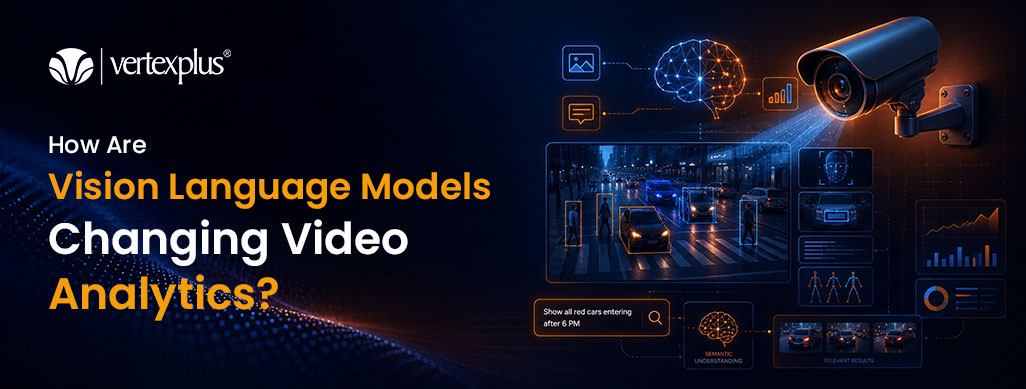
Vision language models are reshaping video analytics by making video searchable, explainable, and far more flexible than classic detection-first systems. Instead of training separate models for every object or event, businesses can now use natural language prompts even to enhance the operations video surveillance analytics software. It? helps you with everything; that is why it is very important to ask what happened, where it happened, and why it matters while using vision-language learning models.
The market is moving quickly. One recent estimate says the global AI-powered video surveillance analytics market was valued at USD 6.95 billion in 2024 and is projected to reach USD 38.50 billion by 2034, growing at a CAGR of 18.7% from 2026 to 2034. Another market release puts the broader AI-powered video analytics market at USD 7.8 billion in 2024 and projects USD 42.2 billion by 2034. These forecasts reflect rising demand for real-time threat detection, behaviour analytics, cloud platforms, and smart-city deployments. For buyers, this means video analytics is no longer a niche security tool. It is becoming an enterprise platform for operations, safety, retail intelligence, logistics, and customer experience.
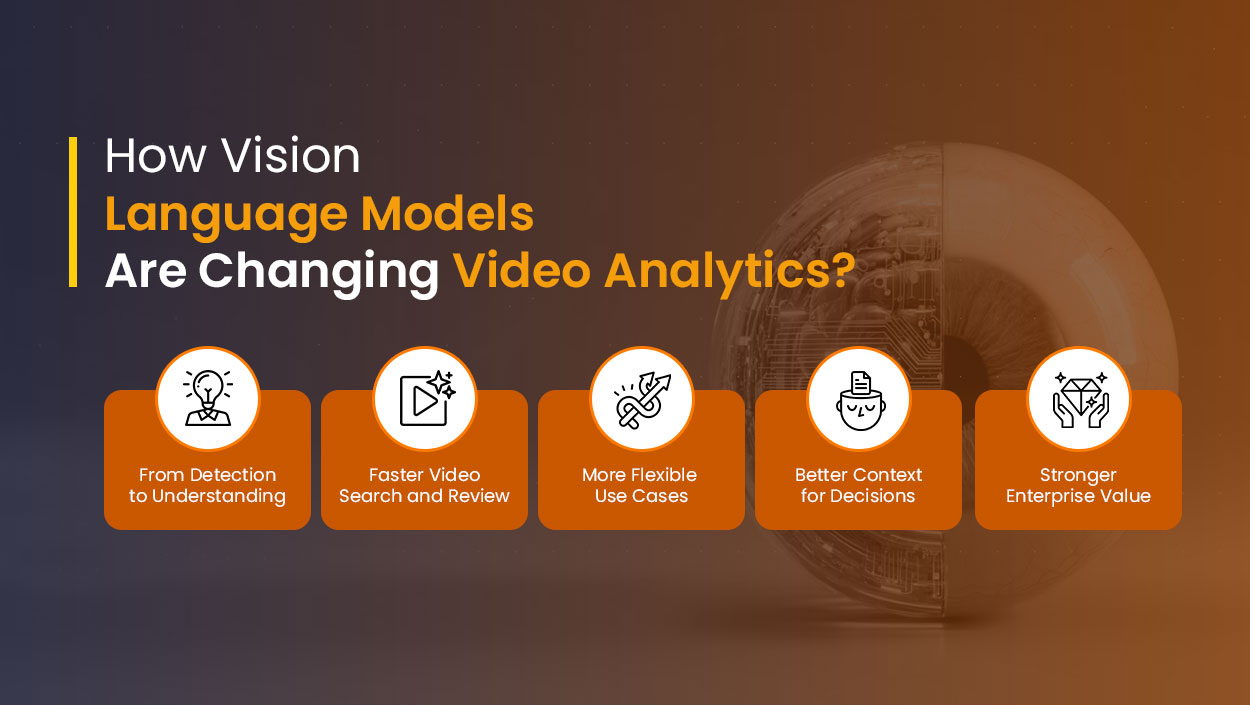
VLMs move beyond simple object detection by interpreting scenes, actions, and context. They help systems explain what is happening in videos, making insights more useful for security and business decisions.
Users can search footage with natural language instead of manual scrubbing. VLMs quickly surface relevant clips, summaries, and events, saving time for security, compliance, and operations teams.
Unlike fixed-rule systems, VLMs adapt to changing needs and new scenarios. They work across retail, manufacturing, hospitality, logistics, and smart buildings with less retraining effort.
VLMs combine visual cues with language reasoning to improve interpretation. This helps distinguish similar events, reduces confusion, and supports more accurate decisions in complex environments.
VLMs reduce manual monitoring and speed up incident review. They improve reporting, operational visibility, and response time, making video analytics more valuable for modern enterprises.
Traditional video analytics usually relies on fixed classes, rigid rules, and repeated retraining when requirements change. VLMs combine a vision encoder with a language model, so they can understand video plus text and answer open-ended questions, summarise scenes, and support visual Q&A. That shift matters because enterprises do not just want alarms; they want context, search, and faster decisions.
VLMs also lower the barrier to adoption for non-technical teams. A security manager, operations lead, or compliance analyst can query footage in plain language instead of depending on custom pipelines or constant model retraining.
VLMs matter because they bridge the gap between raw footage and business language. NVIDIA notes that VLMs can be instructed in natural language and can handle summarisation, visual Q&A, and many classic vision tasks without being locked to a fixed set of classes. That flexibility is a major advantage in fast-changing environments like retail stores, warehouses, airports, hotels, and manufacturing sites.
They are also better aligned with how teams actually work. Most organizations do not need an AI model that only says “person detected”; they need one that can explain "unauthorised entry near the loading dock after hours” or “guest congestion forming at the front desk".
VLM-based systems are already showing value in live operations. NVIDIA describes video analytics AI agents that can detect malfunctioning robots in warehouses, generate out-of-stock alerts, and support automated reporting from video streams. The same approach can help retailers detect shelf gaps, transportation teams identify incidents, and facilities teams monitor safety hazards.
This is where video surveillance analytics software is evolving into a decision layer. It is no longer just about recording events; it is about querying footage, summarising activity, and turning unstructured video into structured insight.
Common enterprise use cases include:
Netflix is a strong example of how VLMs can improve video understanding at scale. In its Video Annotator framework, Netflix used vision-language models plus active learning to help experts build video classifiers more efficiently. The system starts with text-to-video search, then uses a lightweight classifier and active learning loop, and finally lets experts review and refine annotations.
The results were substantial: Netflix reported experiments across 56 labels and 500,000 shots, with a median 8.3-point improvement in Average Precision versus the most competitive baseline. The key lesson is that VLMs can speed up the annotation workflow while keeping domain experts in control.
What enterprises can learn from Netflix:
NVIDIA cites Pegatron as another real-world example of video analytics AI agents in action. By augmenting its assembly process, Pegatron achieved a 7% reduction in labour costs per assembly line and a 67% decrease in defect rates. That is a strong signal that video understanding can affect not only safety and monitoring, but also operational efficiency and quality.
The implementation lesson is practical: when video analytics is tied to a specific process, it can support measurable improvements in cost and defect reduction. VLMs help by adding flexible interpretation on top of raw computer vision outputs, which makes them more useful for manufacturing and operations teams.
Enterprise adoption is strongest where video volume is high and response time matters. In those settings, VLMs help teams triage footage faster, reduce manual review effort, and support investigations without waiting for specialized data labelling cycles. They also fit well into hybrid architectures where edge cameras, cloud inference, and human review work together.
That makes them attractive for buyers evaluating Enterprise Assessment, especially when the goal is to modernise older CCTV setups into intelligent, queryable systems. It also creates opportunities for IT Outsourcing services and an experienced IT Solutions Company like Vertexplus to design integrations, govern access, and connect VLM outputs to dashboards, case management, or alerting tools.
A good rollout starts with one narrow business problem. Pick a workflow with frequent video review, clear labels, and a measurable KPI such as incident review time, queue length, shelf gaps, or defect detection.
A strong deployment path usually includes:
This is also where a partner-led model can help. Many organizations use Enterprise Assessment to identify gaps, then rely on IT Outsourcing services or an IT Solutions Company to handle integration, governance, and rollout.

VLMs are powerful, but they are not flawless. NVIDIA notes ongoing limitations around spatial understanding, small-object detection, and long-context video reasoning. That means businesses should avoid assuming every prompt response is fully reliable, especially in safety-critical settings.
The most important operational safeguard is human oversight. In practice, the best deployments combine automation for scanning and summarisation with reviewer approval for alerts, escalation, and final decisions. That reduces false confidence and keeps the system trustworthy.
Vision language models are changing video analytics from a narrow detection tool into a flexible business intelligence layer. The biggest winners will be organizations that pair VLMs with strong governance, domain expertise, and measurable operating goals
What are vision language models in video analytics?
Vision language models are AI systems that combine visual understanding with language generation, allowing businesses to search, summarise, and interpret video using natural language instead of only fixed labels.
How are vision language models different from traditional video analytics?
Traditional video analytics mainly detects predefined objects or events, while vision language models can understand broader context, answer questions about footage, and adapt more easily to new use cases.
What business benefits do vision language models offer?
They can reduce manual video review, improve incident response, support faster investigations, and make video data more useful for security, retail, manufacturing, and operations teams.
What are the main challenges of using vision language models in video analytics?
Key challenges include accuracy issues in complex scenes, limited spatial reasoning, privacy concerns, and the need for human oversight in high-stakes environments.
Which industries can benefit most from vision language model-powered video analytics?
Industries such as retail, logistics, manufacturing, hospitality, transportation, and enterprise security can benefit the most because they generate large volumes of video that require fast, contextual analysis.

Don’t Worry we are here to increase your business potential with our result-oriented solutions.


Leave a Comment
Your email address will not be published.