

We use cookies to ensure that we give you the best experience on our website.
By using this site, you agree to our use of cookies. Find out more.
 April 21, 2026
|
April 21, 2026
|
 |
|
 Data Annotation
Artificial Intelligence is changing the world from healthcare and stores to security and machines that can do things on their own. Behind every successful Artificial Intelligence system is something very important. Artificial Intelligence models learn by looking at a lot of data. They cannot understand raw data without the right labels. This is where data annotation services come in.
Data annotation is the process of adding labels to data so that machine learning algorithms can see patterns and make guesses. Whether it is finding objects in pictures, tagging keywords in text, or tracking movement in videos for a video analytics solution, annotation helps machines understand and interpret information.
More and more companies use Artificial Intelligence in 2026 and after; they are spending a lot of money on good data annotation tools and professional annotation teams to train smarter Artificial Intelligence models. In this blog we will talk about what data annotation is, the types of annotation, the tools used and why it matters for modern Artificial Intelligence development.
Data annotation is the process of adding labels, tags or metadata to data so machine learning models can understand it. Artificial Intelligence systems use annotated datasets when they are learning to see patterns and relationships in the data. For example, when we train a computer to find cars in pictures, we label the pictures with words like car, road, or traffic signal. We also label text datasets for feelings, keywords or names of people and places.
Artificial Intelligence models are only as good as the data they are trained on. Without labelled datasets, machine learning systems cannot learn well.
Good annotation makes sure that Artificial Intelligence models see patterns correctly and make guesses. This is very important for industries where precision's critical, such as healthcare, money and security. Good data annotation services also help companies reduce mistakes, make training faster and get Artificial Intelligence systems up and running quickly.
For example, surveillance systems that use a video analytics solution rely heavily on annotated video footage to find objects, movements and events in real time.
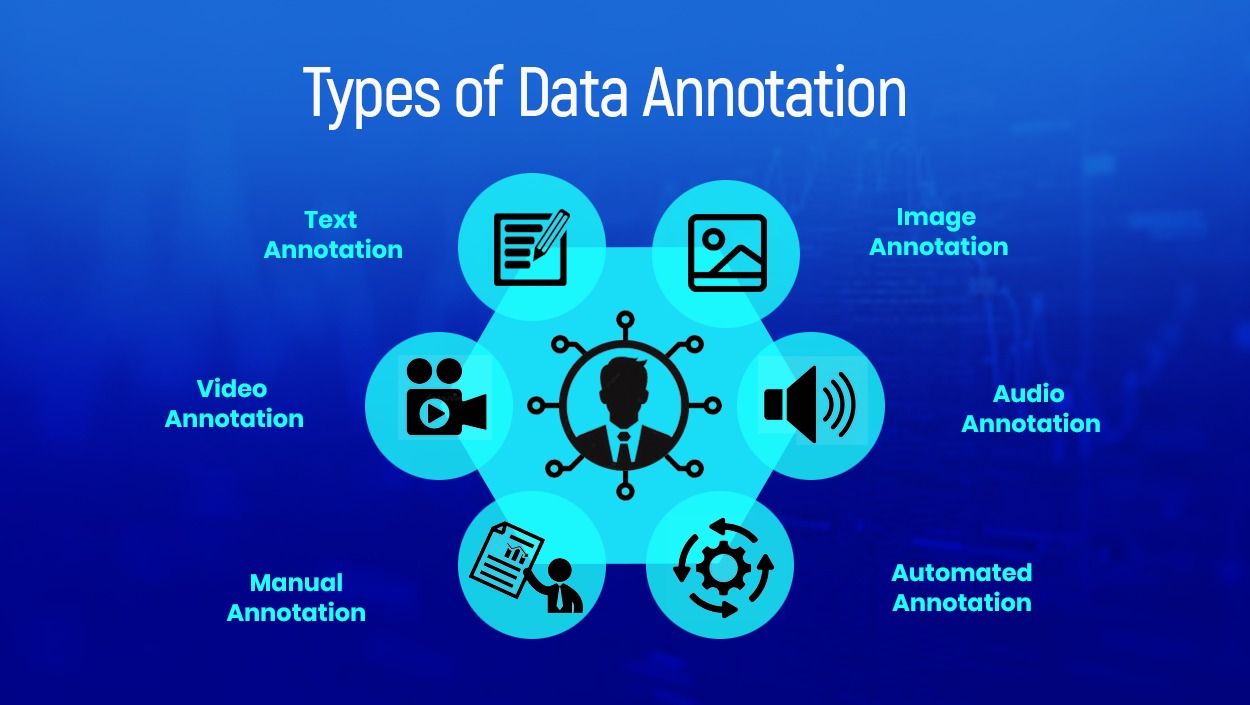
Data annotation can be applied to types of data depending on the Artificial Intelligence application.
Image annotation is one of the common annotation methods. It involves labelling pictures to help computer vision models find objects and understand content. You can use techniques like drawing boxes around objects, labelling parts of pictures, and separating objects from the background. These annotations help AI models find objects like vehicles, people, animals, or products.
Text annotation is used in natural language processing tasks. For example, chatbots need conversations to understand what users are asking. Text annotation is commonly used for sentiment analysis, chatbots, language translation, and search engine optimization.
Audio annotation involves labeling speech data to train voice recognition systems. It helps Artificial Intelligence systems understand spoken language, accents, and speech patterns. Virtual assistants and voice-enabled devices rely heavily on annotated datasets.
Video annotation is used to label objects and actions within video frames. This is very important for surveillance systems and security monitoring. A video analytics solution often depends on video annotation to track people, find activities, and analyze crowd behaviour.
Sensor data annotation is used in the Internet of Things and self-driving machines. It involves labelling data collected from sensors like LiDAR, radar, and GPS. This type of annotation is essential for training self-driving cars and smart city technologies with data annotation tools.
To handle datasets efficiently, companies use specialized data annotation tools. These tools help annotators label data accurately and work together on projects.
Labelbox is a platform that supports picture, text and video annotation. It offers collaboration features and automated labelling capabilities to improve efficiency.
CVAT is an open-source tool commonly used for computer vision projects. It supports picture and video annotation. Is popular among Artificial Intelligence research teams.
Supervisely is an advanced annotation platform designed for computer vision applications. It provides automation features and team collaboration capabilities.
Label Studio uses data annotation tools, which are open-source annotation tools that support multiple data types, including text, pictures and audio.
This cloud-based annotation platform provides automated labelling capabilities using machine learning. It helps reduce the time required for large-scale annotation projects. These data annotation tools companies manage large datasets while maintaining accuracy and consistency.
Read More - The Future of Video Analytics Technology in the Age of AI
Given below are the challenges of using data annotation tools explained in detail:
Video data is becoming one of the valuable sources of information for Artificial Intelligence systems. From traffic monitoring to stores, video-based Artificial Intelligence applications rely heavily on annotated video data.
A modern video analytics solution uses video annotation to find objects, analyse movement, and identify events in time. For example, security systems can automatically find behaviour, while stores can analyse customer movement patterns to improve store layouts. As video data continues to grow, demand for video annotation and advanced data annotation tools will increase significantly.
Data annotation plays a role in the development of modern Artificial Intelligence technologies. Without labelled data, machine learning models cannot understand patterns or make accurate predictions. From picture recognition and natural language processing to surveillance systems powered by a video analytics solution, annotated data enables Artificial Intelligence systems to function effectively. Businesses that invest in reliable data annotation services and advanced data annotation tools can speed up Artificial Intelligence development improve model accuracy, and unlock opportunities for innovation.
1. What do you mean by data annotation services?
Data annotation services involve labelling datasets like pictures, text, audio, or videos so machine learning models can understand patterns and learn effectively.
2. What are the different types of data annotation tools?
Data annotation tools are software platforms used to label and manage datasets for Artificial Intelligence and machine learning projects.
3. Why is data annotation vital for Artificial Intelligence?
Data annotation provides labeled training data that helps Artificial Intelligence models recognize patterns, improve accuracy, and make predictions.
4. How does video annotation assist in developing video analytics solutions?
Video annotation allows Artificial Intelligence systems to find objects and track movement within video footage, enabling video analytics solution capabilities, like surveillance and traffic monitoring.
5. What type of industries use data annotation the most?
Industries, like healthcare, automotive, retail, security, and technology use data annotation a lot. They need data annotation services to teach intelligence systems and make smart applications that work well with data annotation.

Don’t Worry we are here to increase your business potential with our result-oriented solutions.


Leave a Comment
Your email address will not be published.