

We use cookies to ensure that we give you the best experience on our website.
By using this site, you agree to our use of cookies. Find out more.
 April 14, 2026
|
April 14, 2026
|
 |
|
 Video Analytics
In today s hospitality landscape, security is no longer just about installing cameras; it s about intelligent monitoring, predictive insights, and seamless guest experiences. Modern hotels are adopting video surveillance analytics software to transform traditional security systems into proactive, data-driven ecosystems.
This comprehensive guide explores how video surveillance analytics software, video analytics, Network Operation Center, and data annotation services are reshaping hotel security, improving operations, and enhancing guest satisfaction.
Video surveillance analytics software refers to AI-powered systems that analyse video feeds in real time to detect patterns, behaviours, and anomalies. Unlike traditional CCTV systems that merely record footage, these solutions provide actionable insights and automated alerts.
Hotels, with their open environments, multiple entry points, and 24/7 operations, require more advanced monitoring systems. AI-driven surveillance enables hotels to detect suspicious activity instantly, reduce manual monitoring, and ensure faster response times.
Traditional surveillance methods cannot keep up with these complexities. Advanced video analytics systems help hotels shift from reactive security to proactive risk management. For example, AI-powered systems can detect unusual behaviour such as loitering, unauthorized access, or crowd buildup in real time, allowing security teams to act immediately. Hotels face unique security challenges:
GIven below are the steps explained of how video surveillance analytics software works:
Cameras capture real-time footage across hotel premises, including entrances, corridors, parking areas, and common spaces.
The footage is processed using machine learning algorithms that identify objects, behaviours, and anomalies.
The system flags suspicious activities such as the following:
Instant alerts are sent to security teams or the Network Operation Center, enabling quick intervention.
Recorded footage is stored securely and analysed for insights like guest flow, peak hours, and operational efficiency.
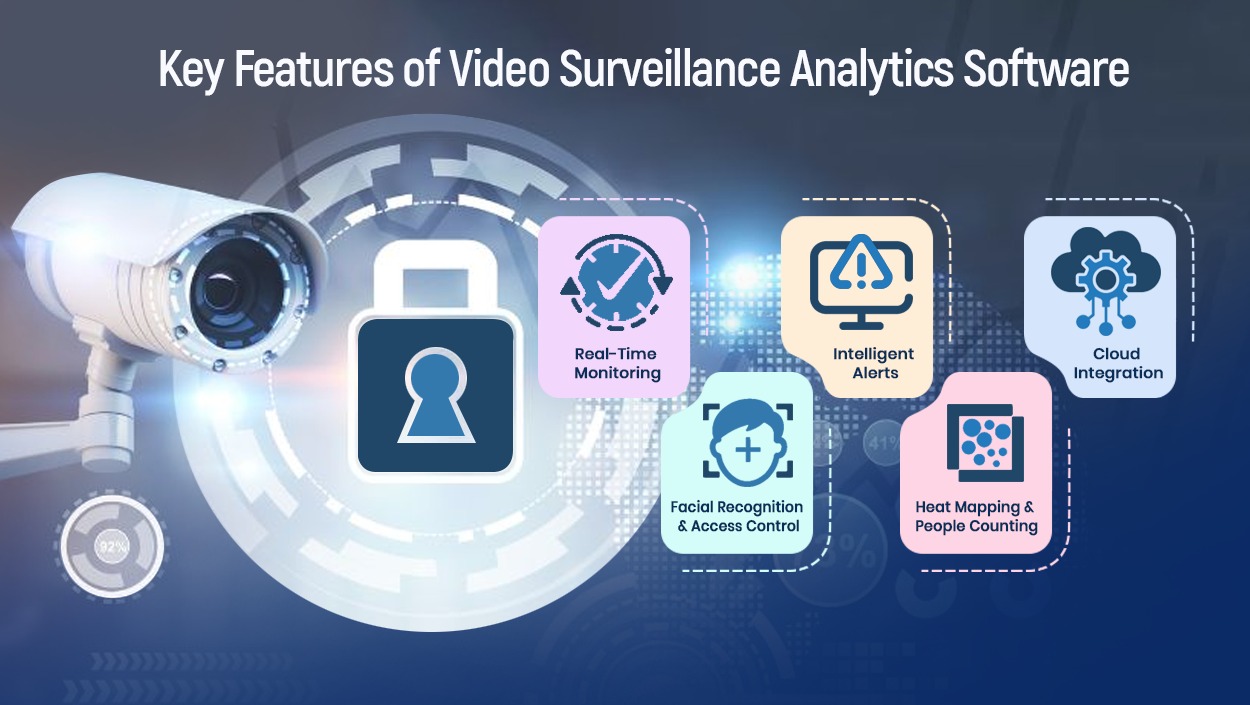
Given below are the key features of video surveillance analytics software explained in detail:
AI-powered video analytics continuously monitors multiple camera feeds simultaneously, enabling instant detection of suspicious activities while reducing manual effort and ensuring faster response to potential security threats across hotel premises.
With video surveillance analytics software, security teams receive real-time alerts for specific incidents, eliminating the need to review hours of footage and allowing quicker, more efficient responses to critical situations.
Facial recognition within video surveillance analytics software ensures only authorised individuals access restricted areas, enhancing security protocols while improving identity verification processes for both guests and staff within hotel environments.
Video analytics uses heat mapping and people counting to track guest movement patterns, helping hotels optimize staffing, manage crowd flow efficiently, and enhance overall operational planning and service delivery.
Cloud-enabled video surveillance analytics software provides remote access to surveillance systems, allowing centralised monitoring, secure data storage, and seamless management of multiple hotel properties from any location in real time.
Video analytics is the core engine behind intelligent surveillance systems. It transforms raw video data into meaningful insights. These capabilities improve situational awareness while reducing reliance on manual monitoring.
Key applications include the following:
A Network Operation Center (NOC) acts as the central hub for monitoring and managing surveillance systems. Hotels with multiple properties benefit greatly from NOC integration, as it allows unified control over security operations.
AI models powering video surveillance analytics software rely heavily on high-quality training data. This is where data annotation services play a critical role.
It is the process of labelling video data to train AI models to recognize objects, actions, and patterns.
GIven below are the benefits of Benefits of Video Surveillance Analytics Software for Hotels
AI-powered surveillance ensures continuous monitoring and immediate detection of threats.
Visible surveillance systems act as deterrents while analytics detect suspicious behaviour early.
Hotels can optimize staffing, manage crowds, and improve service delivery using analytics insights.
Real-time alerts enable quick action, minimising risks and damages.
Recorded footage helps resolve disputes and provides evidence for investigations.
Automation reduces the need for extensive manual monitoring and improves resource allocation.
Given below are the use cases of video analytics software in hotel environments:
In lobby and reception areas, video analytics helps monitor guest check-ins, detect suspicious behaviour, and manage crowd flow efficiently, ensuring smooth operations while maintaining a safe and welcoming environment.
Video surveillance analytics software enhances security in corridors and room areas by detecting unauthorized access, monitoring unusual behaviour, and ensuring guest safety without compromising privacy or comfort during their stay.
In parking areas, video analytics tracks vehicle movement, detects theft attempts, identifies suspicious activities, and monitors accidents, helping hotels maintain security while ensuring a safe and well-managed parking environment.
Video surveillance analytics software monitors crowd density in restaurants and event spaces, helping prevent conflicts, manage large gatherings efficiently, and ensure guest safety during peak hours or special events.
Hotels use video analytics in back-end operations to track staff activity, prevent internal theft, ensure adherence to protocols, and improve operational transparency across restricted and staff-only areas.
The rise of smart hotels has made video surveillance analytics software a critical component of digital transformation. This integration creates a unified security ecosystem that enhances both safety and operational efficiency.
Modern systems integrate with:
Given below are the challenges in implementing video surveillance analytics:
Hotels must carefully handle guest data by complying with regulations and maintaining transparency, ensuring surveillance systems respect personal privacy while balancing security needs and building trust among guests and stakeholders.
Implementing video surveillance analytics software involves upfront investment in hardware, AI technologies, and infrastructure, which can be costly for hotels but delivers long-term value through improved security and operational efficiency.
Integrating video analytics with existing hotel systems like access control, alarms, and management platforms can be complex, requiring technical expertise to ensure seamless communication, compatibility, and efficient performance across systems.
AI-driven systems may generate false alerts due to limited training data or environmental variations, making it essential to continuously refine models using data annotation services to improve accuracy and reliability.
Managing large volumes of surveillance footage requires strong storage, processing, and retrieval systems, ensuring data is organized, secure, and easily accessible for analysis, compliance, and future reference when needed.
GIven below are the best practices for the implementation of video surveillance analytics software:
Proper camera placement ensures full coverage of high-risk and high-traffic areas while avoiding unnecessary intrusion, helping hotels maintain security effectiveness without compromising guest privacy or comfort.
Hotels should invest in scalable video surveillance analytics software that can expand with business growth, supporting additional cameras, locations, and advanced features without requiring complete system replacement in the future.
Seamless integration with existing systems such as IoT devices, alarms, and access controls ensures efficient operations, enabling centralised monitoring through a Network Operation Center for better coordination and response.
Regularly updating AI models and software ensures improved detection accuracy, reduced false alerts, and adaptation to new security threats, keeping the surveillance system effective and aligned with evolving hotel environments.
Hotels must implement strong encryption, secure storage, and access controls to protect sensitive surveillance data, ensuring compliance with regulations while safeguarding both guest information and organisational assets from breaches.
GIven below are the Future Trends in Video Surveillance Analytics
AI-powered video analytics will enable hotels to predict potential security threats by analysing behavioural patterns, helping security teams take proactive measures and prevent incidents before they occur in real time.
Cloud-based video surveillance analytics software allows hotels to store, access, and manage surveillance data remotely, offering scalability, flexibility, and cost-efficiency while enabling centralised monitoring across multiple properties.
Edge computing processes video analytics data closer to the camera source, reducing latency, improving response time, and minimising bandwidth usage, making real-time decision-making faster and more efficient for hotel security operations.
Advanced facial recognition in video surveillance analytics software enhances identity verification, strengthens access control systems, and improves guest personalisation while ensuring higher security standards across restricted and high-risk areas.
Modern video surveillance analytics software will integrate with IoT and smart hotel systems, enabling automated responses, improved monitoring, and seamless coordination between security, operations, and guest experience technologies.
The adoption of video surveillance analytics software is no longer optional for modern hotels; it is essential. By leveraging video analytics, integrating with a Network Operation Center, and utilising data annotation services, hotels can create a secure, efficient, and intelligent environment.
These systems not only enhance security but also improve operational efficiency and guest experience, making them a cornerstone of modern hospitality management.
1. What is video surveillance analytics software in hotels?
Video surveillance analytics software uses AI to analyze video footage in real time, detecting suspicious activities and providing actionable insights for hotel security.
2. How does video analytics improve hotel security?
Video analytics identifies unusual behaviour, detects threats, and sends real-time alerts, enabling faster response and better safety management.
3. What is the role of a Network Operation Center in hotel surveillance?
A Network Operation Centre centralizes monitoring, ensuring efficient management of surveillance systems across multiple hotel locations.
4. Why are data annotation services important?
Data annotation services train AI models to recognize patterns accurately, reducing false alerts and improving system performance.
5. Is video surveillance analytics software expensive to implement?
While initial costs can be high, the long-term benefits—such as improved security, reduced losses, and operational efficiency—make it a valuable investment.

Don’t Worry we are here to increase your business potential with our result-oriented solutions.


Leave a Comment
Your email address will not be published.