

We use cookies to ensure that we give you the best experience on our website.
By using this site, you agree to our use of cookies. Find out more.
 June 26, 2026
|
June 26, 2026
|
 |
|
 Video Analytics
Artificial intelligence has moved from pilot projects to enterprise infrastructure, and Fortune 500 leaders now need governance that is as operational as it is strategic. In 2026, the winning companies will be the ones that treat AI governance as a business capability, one that protects trust, accelerates deployment, and keeps innovation aligned with regulation, risk, and brand values with enterprise assessment services. So read this blog , and know about AI Governance Frameworks Every Fortune 500 Company Needs in 2026
AI adoption is no longer niche: Microsoft’s 2026 Cyber Pulse reporting says more than 80% of Fortune 500 companies are using active AI agents, while 29% of employees report using unsanctioned agents for work tasks. At the same time, only 47% of organizations have dedicated security controls for generative AI, which means many enterprises are scaling faster with enterprise assessment services than their guardrails. That gap is exactly why governance has become a board-level issue rather than a technology-only discussion.
For Fortune 500 firms, weak governance creates real exposure across privacy, bias, cybersecurity, procurement, intellectual property, and operational resilience. Strong governance, by contrast, creates a repeatable way to approve use cases, classify risk, test models, monitor drift, and document accountability. It also helps companies move faster because teams know the approval path instead of negotiating every use case from scratch.
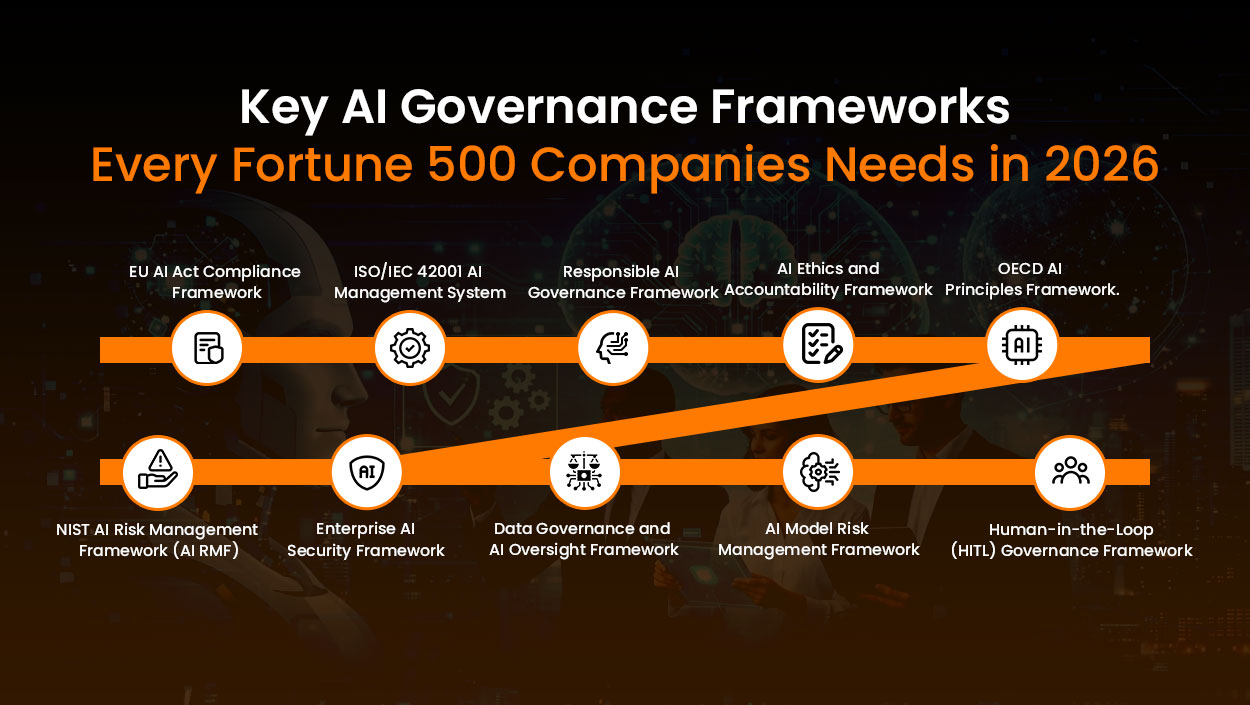
1. NIST AI Risk Management Framework (AI RMF)
Developed by the U.S. National Institute of Standards and Technology, this framework helps organizations identify, assess, manage, and monitor AI risks while promoting trustworthy, transparent, and accountable AI systems.
2. EU AI Act Compliance Framework
Designed to align AI operations with the European Union's AI regulations, this framework categorises AI by risk levels and establishes requirements for transparency, safety, documentation, and human oversight.
3. ISO/IEC 42001 AI Management System
The first international standard specifically for AI management systems, helping organizations establish governance processes, manage risks, ensure responsible AI deployment, and demonstrate regulatory compliance globally.
4. OECD AI Principles Framework
A globally recognized framework promoting human-centered AI through fairness, transparency, accountability, privacy protection, and sustainable innovation while encouraging responsible AI adoption across industries and governments.
5. Responsible AI Governance Framework
An internal enterprise framework that defines ethical AI principles, decision-making responsibilities, bias mitigation strategies, model validation processes, and continuous monitoring to ensure trustworthy AI outcomes.
6. Data Governance and AI Oversight Framework
Focuses on data quality, privacy, security, lineage, and access controls to ensure AI models are trained and operated using reliable, compliant, and ethically managed datasets.
7. AI Model Risk Management Framework
Provides structured controls for evaluating, validating, testing, and monitoring AI models throughout their lifecycle to minimize operational, financial, regulatory, and reputational risks.
8. AI Ethics and Accountability Framework
Establishes guidelines for ethical AI development by defining accountability structures, fairness standards, transparency requirements, and human oversight mechanisms for critical business decisions.
9. Enterprise AI Security Framework
Protects AI systems against cyber threats, adversarial attacks, data poisoning, model theft, and unauthorized access through comprehensive security controls and continuous threat monitoring.
10. Human-in-the-Loop (HITL) Governance Framework
Ensures human oversight remains part of critical AI-driven decisions, enabling organizations to improve accuracy, maintain accountability, address exceptions, and comply with evolving regulatory requirements.
A practical 2026 enterprise approach usually combines several layers rather than relying on one framework alone. The most useful stack includes the NIST AI RMF for risk management, ISO/IEC 42001 for an AI management system with video surveillance, and the EU AI Act for regulatory classification and controls. That combination gives companies a common language for governance, measurable control objectives, and an external compliance anchor.
A robust framework should cover these five pillars:
The best-run companies are shifting from “policy documents” to operating models. That means creating governance councils, model registries, approval workflows, mandatory assessments, and continuous monitoring for both in-house and vendor-built systems with video surveillance. They are also separating low-risk productivity use cases from high-risk decision-making systems, because the controls needed for a chatbot are not the same as those needed for credit, hiring, or surveillance.
Market data suggests the pressure is rising. ISS-Corporate reported that in 2025, 24% of S&P 500 companies disclosed AI frameworks and policies, while 22% disclosed board oversight of AI; however, 60% of companies across the S&P 500 and Russell 3000 still did not disclose specific policies. That tells us governance is improving, but implementation is still uneven, and many firms are operating with a public posture that is weaker than their internal AI adoption with video surveillance.
JPMorgan Chase is often cited as a strong example of governance-first AI scaling with video surveillance services. Public reporting describes an AI Governance Council with approval authority over AI projects, cross-functional oversight, and real-time monitoring across use cases. The company also paired governance with a large internal AI program, including an LLM suite reportedly covering hundreds of use cases and extensive employee training.
The reported results are compelling: improved fraud detection, better lending outcomes, lower bias risk, and stronger trust positioning relative to competitors facing penalties. The lesson for Fortune 500 leaders is straightforward: governance should not be a brake on innovation; it should be the structure that lets innovation scale safely. In regulated industries, that trust dividend can become a competitive moat.
Walmart’s AI strategy shows how governance can be embedded into product design rather than added after launch. Public reporting on Walmart’s retail AI initiatives highlights purpose-built agents, authority boundaries, authentication layers, and human oversight for customer and associate tools with enterprise assessment services. This approach limits agent scope, reduces unintended actions, and ensures the company can scale AI without losing control.
The lesson here is especially relevant for enterprises deploying AI in customer service, operations, and commerce. When an AI system with enterprise assessment services can trigger a purchase, alter inventory, or guide a customer, governance must define what the system is allowed to do and what requires human confirmation. In other words, autonomy must be designed, not assumed.
Fortune 500 companies are already using AI governance to unlock practical business value in several areas. In finance, it supports fraud detection, underwriting, collections, and claims automation by ensuring decisions are explainable and fair. In retail and consumer services, it governs chatbots, recommendation engines, and agentic workflows that interact directly with customers.
In operations and enterprise technology, governance is also critical for internal copilots, document automation, procurement workflows, and knowledge retrieval systems. It becomes even more important in enterprise assessment services, where companies need independent reviews of AI risk posture, control maturity, and framework alignment before board or regulator scrutiny intensifies. The same logic applies to video surveillance use cases, where AI can introduce privacy, bias, and consent risks that require clear policy, human oversight, and documented safeguards.
The strongest governance programs are built like enterprise operating systems. They start with intake and classification, then move into risk review, model testing, approval, deployment, monitoring, and periodic reassessment. Many firms are now formalising AI governance, video surveillance that councils that include legal, risk, compliance, data science, cybersecurity, procurement, and internal audit.
A modern operating model should also include these practices:
In 2026, Fortune 500 companies need AI governance frameworks that are operational, measurable, and board-ready. The organizations that win will not be the ones using the most AI Video surveillance, but the ones that can prove their AI is safe, fair, compliant, and aligned with business goals. A mature framework turns AI from a risk magnet into a scalable advantage.
1. What is an AI governance framework, and why is it important in 2026?
An AI governance framework is a structured set of policies, processes, and controls that guide the responsible development, deployment, and monitoring of AI systems. In 2026, it is essential for ensuring compliance, reducing risks, improving transparency, and maintaining stakeholder trust as AI adoption expands across enterprises.
2. What are the key components of an effective AI governance framework?
A robust AI governance framework typically includes AI ethics policies, risk management protocols, data governance standards, model monitoring processes, regulatory compliance measures, accountability structures, and cybersecurity controls. These components help organizations manage AI responsibly and at scale.
3. How can Fortune 500 companies ensure AI regulatory compliance?
Organizations can ensure compliance by establishing clear governance policies, conducting regular AI audits, maintaining detailed documentation, implementing explainable AI practices, and aligning their operations with emerging global regulations such as the EU AI Act and other industry-specific standards.
4. What risks can AI governance frameworks help mitigate?
AI governance frameworks help reduce risks related to data privacy breaches, algorithmic bias, security vulnerabilities, regulatory penalties, inaccurate decision-making, and reputational damage. They provide oversight mechanisms that promote safe and ethical AI usage.
5. How often should enterprises update their AI governance strategies?
AI governance strategies should be reviewed and updated at least annually, or whenever significant regulatory changes, technological advancements, or business transformations occur. Continuous monitoring and periodic assessments ensure governance practices remain effective and relevant.

Don’t Worry we are here to increase your business potential with our result-oriented solutions.


Leave a Comment
Your email address will not be published.