

We use cookies to ensure that we give you the best experience on our website.
By using this site, you agree to our use of cookies. Find out more.

 June 12, 2026
|
June 12, 2026
|
 |
|
 AI chatbot
The agentic AI revolution has arrived in corporate America, and it's moving faster than most executives anticipated. More than 80% of Fortune 500 companies now have active AI agents, yet only about 11% have achieved true production-scale deployment. This gap between pilot programs and operational reality defines the enterprise AI landscape in 2026, separating industry leaders from those still stuck in "deployment theatre".
As organizations transition from experimental generative AI they an reach out to IT Solutions Company to get autonomous, goal-driven solutions that can enforce agentic AI in reshaping how the world's largest enterprises work. Unlike earlier AI tools that generated content or provided recommendations.
AI executes decisions and actions across complex systems with minimal human intervention. This shift from assistive to autonomous capabilities represents the most significant enterprise technology transformation of the decade with enterprise assessment services.
Agentic AI refers to intelligent systems capable of autonomously pursuing objectives rather than simply generating outputs. An AI agent interprets goals, plans actions, uses tools or APIs, and adapts behaviour based on outcomes or changing conditions with IT Outsourcing Services.
This distinction is critical for enterprise strategy. Generative AI stops at outputs, but agentic AI is measured by outcomes. AI agents operate across systems, not within isolated applications, enabling continuous execution and adaptive decision-making across cloud operations, finance, IT, security, and software delivery.
The 2026 Inflection Point
According to Gartner, by 2026, 40% of enterprise applications will embed task-specific AI agents, up from less than 5% just a few years ago. The global agentic AI market is expected to reach $89.6 billion in 2026, representing roughly 215% year-over-year growth. Multiple forces converge in 2026 to accelerate agentic AI adoption:
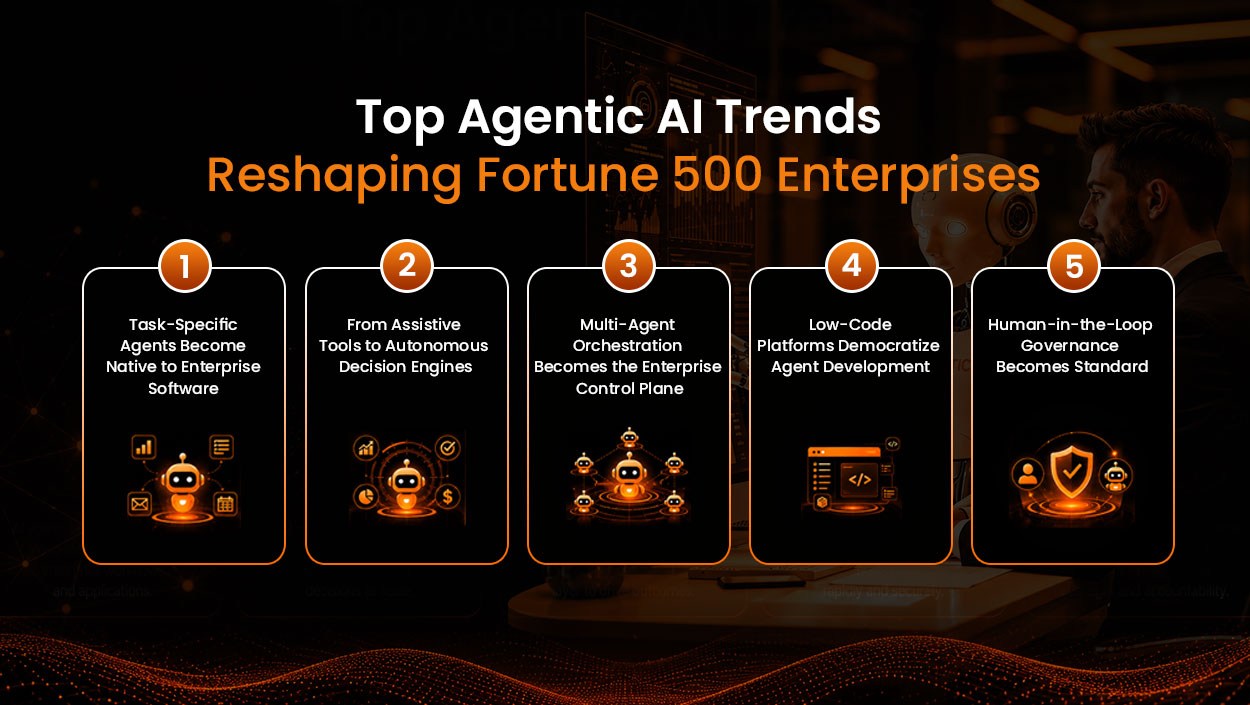
By 2026, agentic AI is no longer something enterprises "add on"—it's built directly into core platforms. Organizations are deploying task-specific AI agents that take ownership of clearly defined responsibilities inside everyday enterprise systems developed with
enterprise assessment services.
These AI agents handle functions such as:
One of the clearest developments is the progression of AI agents beyond assistive roles. Instead of supporting human decisions, agentic systems are increasingly trusted to make decisions within well-defined boundaries. While using IT Outsourcing Services, AI agents evaluate trade-offs, execute actions, and learn from outcomes. Humans stay involved, but their role shifts toward oversight, exception handling, and strategic direction.
As enterprises deploy dozens or hundreds of AI agents, coordination becomes critical. Agentic AI orchestration platforms function as enterprise control planes, governing how AI agents collaborate, escalate issues, and comply with policies.
These orchestration layers manage:
80% of Fortune 500 companies have active AI agents built with low-code/no-code tools. This acceleration means employees in HR, finance, customer support, and operations can create intelligent assistants that support their own workflows without technical expertise. The greatest adoption increase was in EMEA (42%), followed by the U.S. (29%), Asia (19%), and the Americas (10%).
Greater autonomy doesn't mean removing humans from the process. Enterprises are formalising human-in-the-loop governance as the standard operating model. AI agents execute actions independently within defined thresholds, while humans intervene in high-risk, ambiguous, strategic, or exceptional scenarios. Only 21% of organizations have a mature governance model for agentic AI a critical gap as deployment velocity outpaces oversight capabilities.
Customer-facing agents represent the largest category of production deployments. Modern contact centre agents handle refunds, escalations, appointment scheduling, and omnichannel routing without human handoff for the majority of interactions with IT Outsourcing Services.
Results from a major retailer: Deploying an AI sales and service agent achieved:
AtlantiCare, a health system in Atlantic City, deployed an agentic clinical assistant for ambient note generation across 50 providers, achieving:
Organizations report compressing financial close cycles by 30-50% with agentic workflows. On the IT side, AI agents are the primary driver of network operations automation handling incident detection, root-cause analysis, and remediation routing without L1 ticket queues.
Fortune 500 engineering teams deploy coding agents for specific tasks: PR review, test generation, documentation, and dependency scanning. Productivity gains in the 20-40% range for targeted tasks are commonly reported.
Walmart's approach to agentic AI is surgical and purpose-built. The retail giant leverages its retail-specific LLM to build agents for tasks such as item comparison, deep personalisation, and shopping journey completion within its GenAI-powered shopping assistant.
Lessons Learned
JPMorgan's 2026 technology budget stands at $19.8 billion, and the bank has formally reclassified AI from experimental R&D to core business infrastructure. This accounting reclassification signals that AI is no longer being tested; it's being depended upon for critical operations.
What took a team of analysts two days can now be completed in minutes by AI agents running in JPMorgan's cloud infrastructure.
Lessons Learned
Moving AI from R&D to infrastructure signals organizational commitment
The combination gives systems understanding of both general context and specialized financial regulation
Companies that move earliest gain lasting advantages that take years to overcome
Despite 80% adoption at the pilot level, only 1 in 9 enterprises runs agents in true production at scale. The barriers are consistent across sectors:
Security and governance are the top barrier, with Microsoft's data showing that agentic deployments create novel attack surfaces: agents with broad tool-calling permissions, access to production APIs, and the ability to take real-world actions represent a different threat model than passive AI assistants, and that too can be supported with IT Outsourcing Services.
System integration remains the hardest operational challenge; the difficulty isn't the intelligence but secure, reliable, auditable access to production systems (CRMs, ERP platforms, ticketing tools, internal APIs, and data warehouses).
The trajectory is clear. 74% of executives who have deployed AI agents report achieving ROI within the first year. However, the organizations reporting the highest returns are those that started with well-scoped, high-frequency tasks with clear measurement frameworks.
By 2027, 74% of respondents expect their companies to be using AI agents at least "moderately", with 23% expecting "extensive" use and 5% expecting full integration as core business operations.
Gartner predicts that 40% of agentic AI projects will be cancelled by the end of 2027 primarily due to strategic and organisational obstacles rather than technical challenges. The deeper obstacles include reimagining processes built for human execution and implementing governance structures for systems that act independently.

Agentic AI is no longer experimental; it's operational, measurable, and essential for enterprise competitiveness in 2026 and beyond. The 80% Fortune 500 adoption headline is real, but the 11% production-scale figure is where the interesting work is happening.
Enterprises that treat agent deployment as a software procurement problem will find themselves stuck at the pilot stage. Those that treat it as an organisational capability-building problem, investing strategically in AI infrastructure, talent, governance, and workflow redesign, will pull ahead and gain compounding competitive advantages.
The agentic era has arrived. The question isn't whether your organisation will adopt agentic AI; it's whether you'll lead the transformation or play catch-up.
1. What is the difference between generative AI and agentic AI in enterprise settings?
Generative AI creates content (text, images, code) based on prompts, while agentic AI autonomously executes tasks and makes decisions within defined boundaries. For example, generative AI might draft an email, but agentic AI can send it, track responses, and follow up automatically.
2. Why do only 11% of Fortune 500 companies have agentic AI in true production despite 80% adoption?
Most enterprises are stuck in pilot programs due to security concerns (80%), system integration challenges (46%), and immature governance models (only 21% have mature frameworks). The technology works, but scaling requires reimagining processes built for human execution.
3. What are the biggest risks of deploying agentic AI at enterprise scale?
Agentic AI creates novel attack surfaces because agents have access to production APIs and can take real-world actions. Security risks include unauthorized tool-calling permissions, data privacy breaches, and lack of audit trails. Organizations must implement human-in-the-loop governance as their standard operating model.
4. How quickly can Fortune 500 companies expect ROI from agentic AI investments?
74% of executives report achieving ROI within the first year when they start with well-scoped, high-frequency tasks with clear measurement frameworks. Customer service agents and coding assistants typically deliver the fastest returns.
5. Should enterprises build agentic AI capabilities in-house or partner with an IT Solutions Company?
It depends on your Enterprise Assessment results. Companies with strong AI talent (like JPMorgan's 2,000 AI staff) build proprietary capabilities, while others use IT Outsourcing Services for faster scaling. The key is balancing speed-to-market with long-term competitive advantage.

Don’t Worry we are here to increase your business potential with our result-oriented solutions.


Leave a Comment
Your email address will not be published.